

Your draft for a writing class comes back with a Turnitin report, and now you are trying to figure out whether the AI score came from Turnitin itself or from some outside detector.
That question matters because students often assume every score works the same way. It does not.
The next step is to separate Turnitin's own report from public detector guesses.

Quick Answer to What AI Detector Does Turnitin Use
Turnitin presents its AI writing detection as its own AI writing capability and AI writing detection model, not as a named third-party checker added onto the report. For a student, that means the AI Writing Report should be read as part of Turnitin's internal reporting system rather than as a repackaged version of a public detector you can easily compare score for score elsewhere.
In its documentation, Turnitin says the feature is designed to help educators identify text that might be prepared by generative AI tools, chatbots, word spinners, and bypasser tools. It also warns that the model may misidentify human-written, AI-generated, and AI-paraphrased text. That caution matters because the report is not presented as automatic proof of misconduct.
The practical answer is simple: when an instructor refers to Turnitin AI detection, they are generally referring to Turnitin's own model and report categories. You can see that framing in Turnitin's AI Writing Report guide and its AI writing detection model page. So if you are trying to determine whether your campus is relying on a separate outside detector, Turnitin's public explanation points back to Turnitin's own AI writing system.
What Turnitin Says About Its AI Writing Model
Turnitin's public language is careful, and that is a good thing for students to notice. The company does not say the AI Writing Report proves a violation. Instead, it says the capability is designed to help educators identify text that may have been prepared by AI systems and related rewriting tools. That wording leaves room for instructor judgment, assignment context, and student explanation.

Turnitin also says the AI percentage is different from and independent of the Similarity score. A paper can therefore show source overlap without much AI-indicated text, or show AI-indicated text without a dramatic similarity percentage. Students sometimes combine those numbers into one impression of guilt, but Turnitin's own materials do not treat them that way.
Turnitin's instructions for accessing the report also explain AI detection accuracy limits. The AI Writing tab contains the overall percentage of text detected as AI within the newer Similarity Report interface. Turnitin also notes that scores below 20% may appear with an asterisk in some views because lower-range results are less reliable and false positives are more likely. That does not make higher percentages self-explanatory. It means students and instructors still need to read the report carefully and remember Turnitin's warning that the model should not be the sole basis for adverse action.
How the Report Separates Ai-generated and Ai-paraphrased Text
One reason students ask whether Turnitin uses some outside detector is that they expect a simple yes-or-no label. Turnitin's own model description is more structured than that. According to the company, the interactive AI report distinguishes between AI-generated only text and AI-generated text that was AI-paraphrased. That tells you the report is trying to categorize different kinds of AI-related writing signals rather than just assigning a single generic suspicion score.
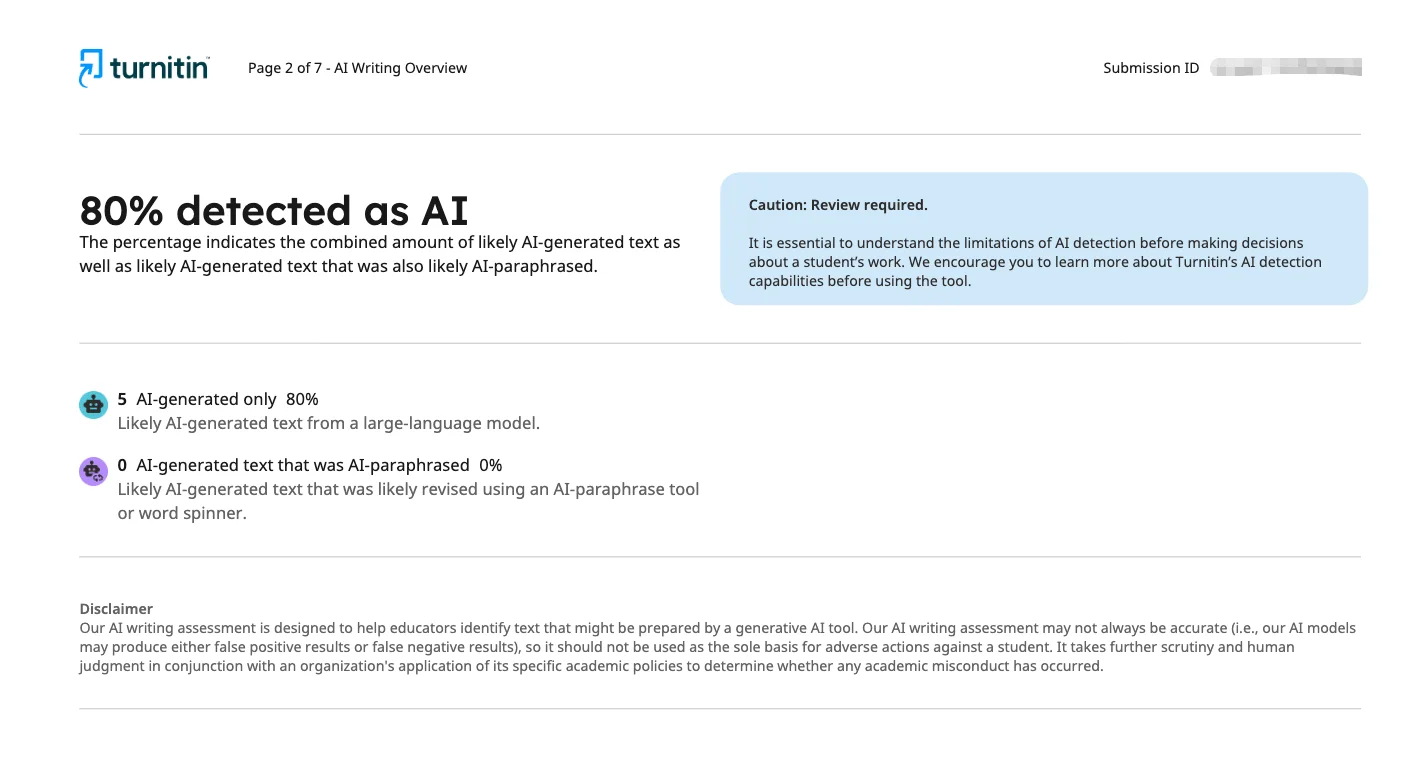
Turnitin also names QuillBot as an example of an AI paraphrasing tool or word spinner in this context. For students, that matters because paraphrased machine-like text is not treated as a completely separate issue from generated text. The report framework suggests Turnitin is looking at both direct AI-style output and output that has been altered through AI paraphrasing tools.
Report Category | What Turnitin Says It Represents | Why It Matters for Students |
|---|---|---|
AI-generated only | Text the model identifies as AI-generated | May point to passages that read like direct machine output |
AI-generated text that was AI-paraphrased | Text identified as AI-generated and then altered through AI paraphrasing tools | May affect drafts revised with paraphrasing or word-spinner tools |
This distinction also has an academic integrity implication. If your course allows limited brainstorming help but expects the final draft to reflect your own authorship, running text through paraphrasing tools does not necessarily solve the underlying concern. A better response is to revise from your own notes, add course-specific reasoning, and make sure you can explain how the paper developed.
Why the Model Is Not the Same as a Similarity Checker
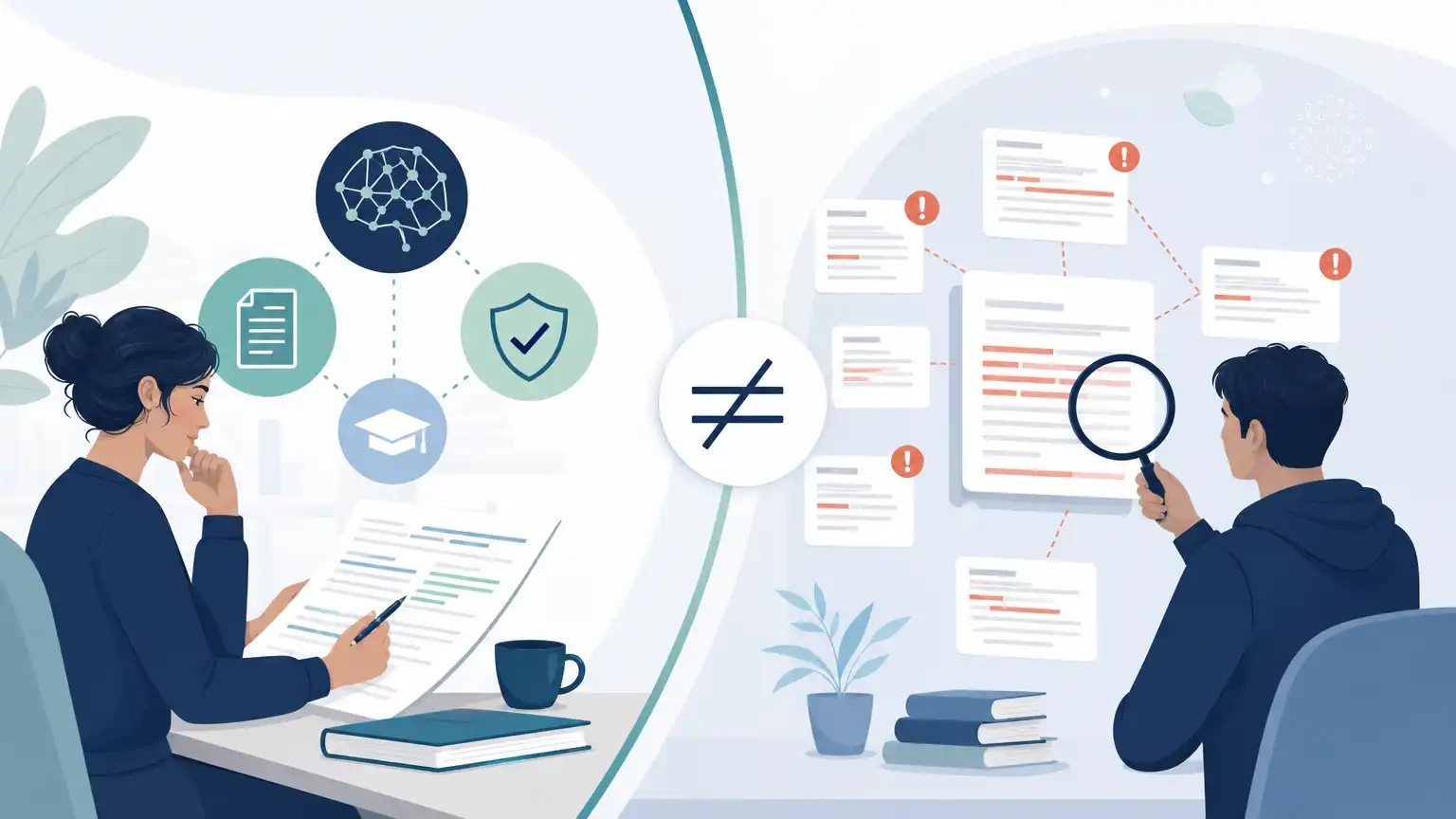
Many students use the words plagiarism checker, similarity checker, and AI detector as if they mean the same thing. Turnitin's own documentation separates them. Its plagiarism checking service compares overlapping text against existing sources. In Turnitin's plagiarism blog, the company says it does not detect plagiarism by itself; it identifies similarity that instructors must interpret. A match could reflect quotation, common phrasing, a template, missing citation, or copying. Context matters.
The AI Writing Report works differently. Instead of measuring overlap with published or submitted text, it estimates whether writing appears AI-generated or AI-paraphrased. That is why Turnitin explicitly says the AI percentage is independent of the Similarity score. One number is about overlap; the other is about writing patterns the model associates with AI-related production.
Feature | Main Question It Addresses | Important Student Caution |
|---|---|---|
Similarity score | How much text overlaps with existing material? | High or low scores do not automatically prove or disprove plagiarism |
AI writing indicator | How much text appears AI-generated or AI-paraphrased? | Turnitin says the model may misidentify text and should not be the sole basis for adverse action |
This difference is especially useful when you speak with an instructor. If a report shows both kinds of information, ask which part they are discussing. A similarity concern and an AI-writing concern are related to academic integrity, but they are not the same claim and should not be treated as interchangeable.
What Turnitin Does Not Reveal About Detection
Students often want a precise technical name, a public benchmark, or a comparable public AI detector they can test before submitting. Turnitin does not publicly provide that level of disclosure. Its pages describe an AI writing detection model, explain report categories, and provide cautions about interpretation, but they do not publish a full proprietary formula or a detailed recipe for how every passage is classified.

That means broad claims such as “Turnitin uses the exact same detector as this public website” are not supported by Turnitin's official materials. The same goes for claims that one small wording change or formatting trick will guarantee a clean result. Turnitin's release notes describe ongoing enhancements related to AI writing detection, AI bypasser tools, report downloads, and Similarity Report behavior, which suggests the system evolves over time.
Turnitin also gives practical file guidance that affects whether reports process correctly. It recommends using a consistent file format across students when AI writing detection is used for an assignment. It warns that PDFs with non-selectable text, embedded extra files, or unreadable formatting may be rejected or fail to process properly. Those are not shortcuts around detection. They are reminders that clean submission practices matter. If you are worried about a report, save drafts, submit a readable file, and be ready to explain your writing process honestly.
Key Takeaways About Turnitin's AI Detector
If you need the short version before office hours or before a resubmission window closes, these are the points worth remembering.
Turnitin describes the feature as its own AI writing capability and AI writing detection model, not as a publicly named third-party checker for students.
The report is meant to help educators identify writing that may have been prepared by generative AI tools, chatbots, word spinners, and bypasser tools.
Turnitin says the model may misidentify human-written, AI-generated, and AI-paraphrased text.
The AI percentage is separate from the Similarity score, so those numbers should not be blended into one final judgment.
Turnitin describes two interactive categories: AI-generated only and AI-generated text that was AI-paraphrased.
Scores below 20% may appear with an asterisk in some views because lower-range results are less reliable and false positives are more likely.
A few workflow details help too. Turnitin says uploaded files can take about 10 to 15 minutes to process, while overwritten or resubmitted papers may take up to 24 hours for a new Similarity Report. It also says three resubmission attempts may generate reports immediately, but after three attempts a 24-hour wait can apply. Only one document may be submitted to a standard assignment, though some students may submit through an instructor-provided direct submission link without creating an account.
Frequently Asked Questions
Is Turnitin Using a Third-party AI Detector?
Turnitin's public documentation presents the AI Writing Report as part of Turnitin's own AI writing detection system. It does not publicly describe the feature as a separately branded outside detector inserted into the platform.
Can Turnitin Detect Ai-paraphrased Text?
Turnitin says its model includes a category for AI-generated text that was AI-paraphrased. It also names QuillBot as an example of an AI paraphrasing tool or word spinner in that context. Even so, Turnitin warns that the model can misidentify text, so the report is not absolute proof by itself.
Is the AI Score the Same as the Similarity Score?
No. Turnitin explicitly says the AI percentage is different from and independent of the Similarity score. Similarity reflects text overlap with sources, while the AI indicator reflects text the model identifies as AI-generated or AI-paraphrased.
What Does the Asterisk Below 20% Mean?
Turnitin says that in some views, scores below 20% are shown with an asterisk because results in that range are less reliable and false positives are more likely. Students should read that as a caution against overinterpreting low-range results.
How Long Does a New Report Take After Resubmission?
Turnitin says uploaded files can take 10 to 15 minutes to process in normal circumstances. If a paper is overwritten or resubmitted, a new Similarity Report may take up to 24 hours. It also notes that the first three resubmission attempts may generate reports immediately, but after three attempts a 24-hour wait may apply.
What If My Writing Sounds Too Mechanical?
Do not try to game the report. Revise ethically by adding your own examples, clarifying your reasoning, varying sentence rhythm, and making sure the final wording reflects your real understanding. If AI-assisted writing was allowed in your course, keep notes on your drafting process. If you need help smoothing robotic phrasing, Dr. Humanizer may be useful, but your final submission still needs to match course policy and your own authorship.
Conclusion on What AI Detector Does Turnitin Use
For students wondering what AI detector does turnitin use, the clearest public answer is that Turnitin describes its own AI writing detection model inside the AI Writing Report rather than identifying a separate third-party detector that students can simply replicate elsewhere. Turnitin also makes the limits clear: the AI percentage is separate from similarity, lower-range results may be less reliable, and the report should not be the sole basis for adverse action.
If your report raises concerns, focus on context instead of panic. Review any highlighted sections, compare them with your drafting history, confirm that your file uploaded in a readable format, and ask your instructor how they interpret the report in your course. A calm explanation of your process, supported by real drafts and honest revision choices, will usually help far more than guessing at hidden technology.