

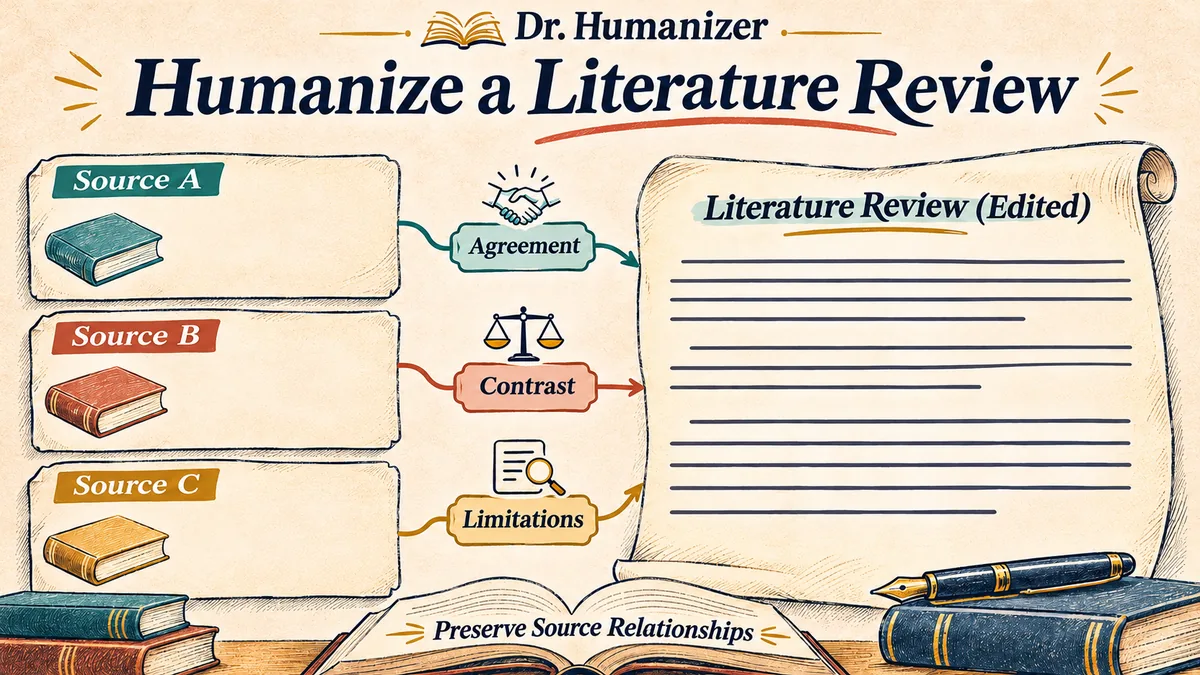
To humanize a literature review, improve how readers follow the research conversation without changing what the sources say. Keep each finding attached to the right study, preserve qualifications, and retain the difference between agreement, disagreement, and a difference in research design. A smoother paragraph is useful only if its synthesis remains accurate.
This is a revision process for a review you have already researched. It starts with a source check, then addresses overloaded sentences and mechanical transitions. If you are still selecting studies or organizing themes, begin with the broader guide to writing a literature review.
Protect the Relationships Before Changing the Words
A literature review does more than summarize several papers. It explains how their findings relate. That relationship can change even when all the author names and citations survive an edit. Replacing “extends” with “confirms,” for example, can turn a study of a new setting into evidence that reproduces an earlier result.
Before revising a paragraph, create a small claim map from your own reading notes. Record the source, its relevant finding, the conditions under which that finding applies, and the relationship your paragraph assigns to it. Do not ask a rewriting tool to infer these details from a reference list.
Element to Preserve | Question to Ask | Revision Risk |
|---|---|---|
Finding | What did this study actually report? | A participant's account becomes an objective outcome. |
Scope | Which population, setting, or task was examined? | A local result becomes a claim about all students. |
Relationship | Do the studies agree, contrast, or examine different things? | Different outcomes are presented as contradictory findings. |
Attribution | Which source supports each clause? | A citation moves to the end of a claim its source does not support. |
Keep this map beside the draft. It becomes the acceptance standard for every wording change, rather than a new outline that replaces the work you already did.
Revise a Synthesis Paragraph in Two Passes
First Pass: Make the Research Relationship Explicit
Read the paragraph's opening and closing sentences. The opening should identify the issue or relationship; the closing should explain its significance without claiming more than the sources establish. Between them, introduce each study at the point where readers need its evidence.
Use a comparison verb only after checking that it describes the evidence. “Challenges” implies a conflict. “Examines a different outcome” may be more accurate when one study measures confidence and another measures performance. A natural transition names the real connection rather than disguising a missing one.
Second Pass: Reduce the Reading Burden
Once the relationship is secure, shorten unnecessary framing and separate sentences that carry too many jobs. You can replace “It is important to note that the authors found” with a direct statement of the finding. You should not remove a limitation simply because it makes the sentence longer.
Keep useful repetition: repeat a technical term when a synonym could change its meaning.
Resolve vague references: replace “this” or “these findings” with the specific result when several studies are nearby.
Vary structure for a reason: split a sentence to separate a finding from its limitation, not merely to create different sentence lengths.
Retain uncertainty: keep words such as “may,” “in this sample,” and “was associated with” when they express the evidence accurately.
See How a Small Edit Can Change the Synthesis
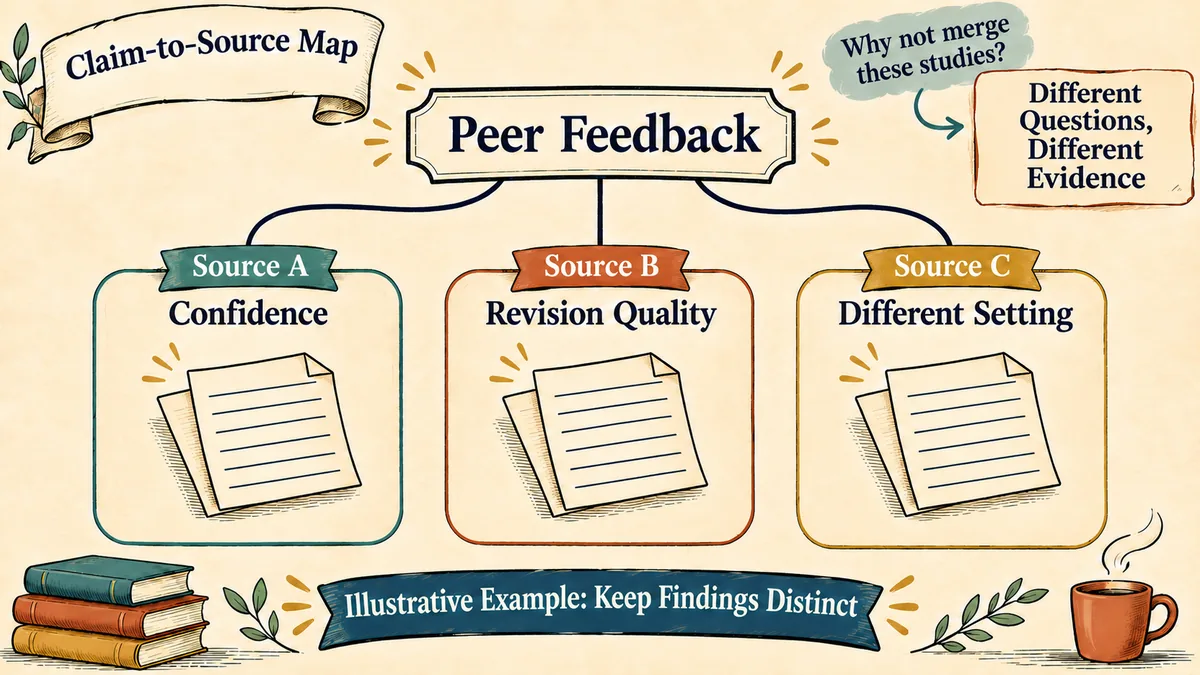
Illustrative example: the studies and findings below are invented to demonstrate revision choices. They are not evidence about peer feedback.
Draft: Lee's study linked peer feedback with greater reported confidence, whereas Patel's study measured revision quality and found no clear improvement. Because the outcomes differed, the findings do not directly contradict one another.
A careless summary would say, “Studies disagree about whether peer feedback works.” That sentence removes the distinction between confidence and revision quality. It also introduces a broad measure of success that neither hypothetical finding establishes.
Clearer revision: The studies assessed different outcomes. Lee examined reported confidence; Patel assessed revision quality. Their findings therefore answer different questions rather than directly contradicting each other.
In your actual review, retain each study's real citation beside the relevant statement. Check the sources again before accepting the revision. If the original paragraph contains a methodological limitation, keep that limitation too; this short example does not give permission to discard it.
Use Dr. Humanizer Within a Defined Editing Boundary
If your assignment permits AI-assisted editing, Dr. Humanizer can be part of the wording stage. Start with a paragraph whose source relationships you have already verified. Save the original and compare any proposed rewrite against the claim map, including citations, technical terms, and qualifications.
Do not treat fluent wording as confirmation that the underlying synthesis is correct. A rewriting tool cannot replace reading the cited studies. If a proposed sentence combines claims, changes a contrast into agreement, or introduces a conclusion, reject or manually repair that change before using it.
Work in coherent passages rather than isolated clauses when context matters. Afterward, read the paragraphs on both sides: a revised opening may repeat an earlier point or remove the transition into the next theme. The distinction between humanizing and paraphrasing is useful here, but neither label removes the need to verify meaning.
Run a Final Source-to-Paragraph Check
Read for source ownership. Identify the source behind every factual claim and make your own interpretation distinguishable.
Check relationship words. Revisit “supports,” “contrasts,” “extends,” and similar verbs against the studies.
Audit boundaries. Confirm that populations, outcomes, dates, and limitations survived the edit.
Match citations. Check that the citation still points to the correct reference entry and relevant passage.
Read the theme aloud. Assess whether the paragraph now explains the research conversation more clearly.
FAQ
Should I Replace Every Repeated Author Name?
No. Attribution sometimes requires repetition. Vary sentence openings where it helps readability, but do not replace a clear source name with an ambiguous pronoun merely to avoid repetition.
Can I Combine Citations at the End of a Paragraph?
Only when the source-to-claim relationship remains clear and the required citation style permits the presentation. A cluster at the end should not imply that every listed source supports every preceding sentence.
Does Humanizing Mean Making the Review Conversational?
Not necessarily. The goal is readable academic prose. Keep the register appropriate to the discipline and assignment; clarity does not require slang, personal anecdotes, or reduced technical precision.
Conclusion
A natural literature review makes relationships easier to understand while leaving the evidence intact. Map the claims, revise the reasoning before the wording, and check attribution after every structural change. Accept the edit when a reader can follow the synthesis more easily and still reach the same source-supported interpretation.