

To humanize a scholarship essay, revise the story you actually lived: replace vague claims with precise actions, vary sentence rhythm, and keep your own interpretation.
Start with a draft you wrote. Check the scholarship's assistance rules before using any tool; permission for grammar checks does not automatically permit rewriting.
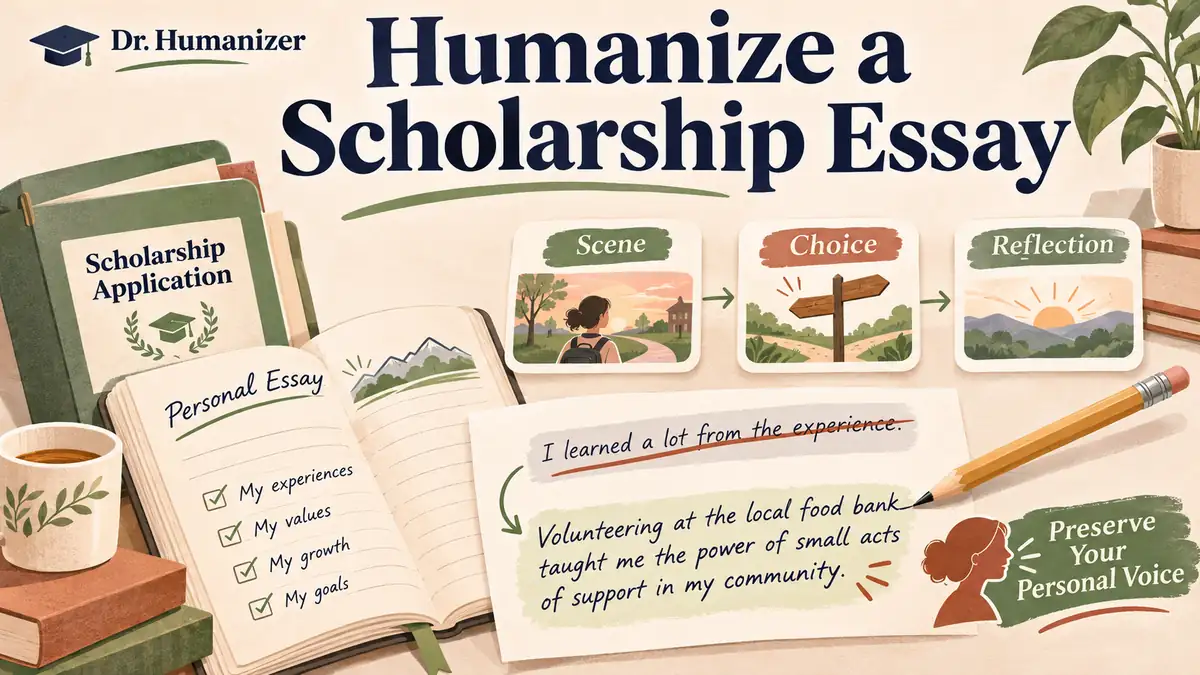
Revise the Scene, Then Adjust the Rhythm
A natural voice comes from choices the reader can understand. More adjectives rarely help. Find the moment when you made a decision and show what changed.
Replace a Broad Claim With an Observable Action
Underline sentences such as “I learned resilience” or “I became a leader.” Keep the insight, but give it a specific basis from your experience.
Draft Problem | Revision Question | Keep It Honest |
|---|---|---|
A general quality | What did I actually do? | Use an action you can explain. |
A dramatic summary | Which small moment carries the meaning? | Do not invent dialogue or details. |
A polished lesson | What changed in my next decision? | Allow uncertainty where it existed. |
Invented teaching example: the following sentences demonstrate revision. They are not a student's real application or a model answer to submit.
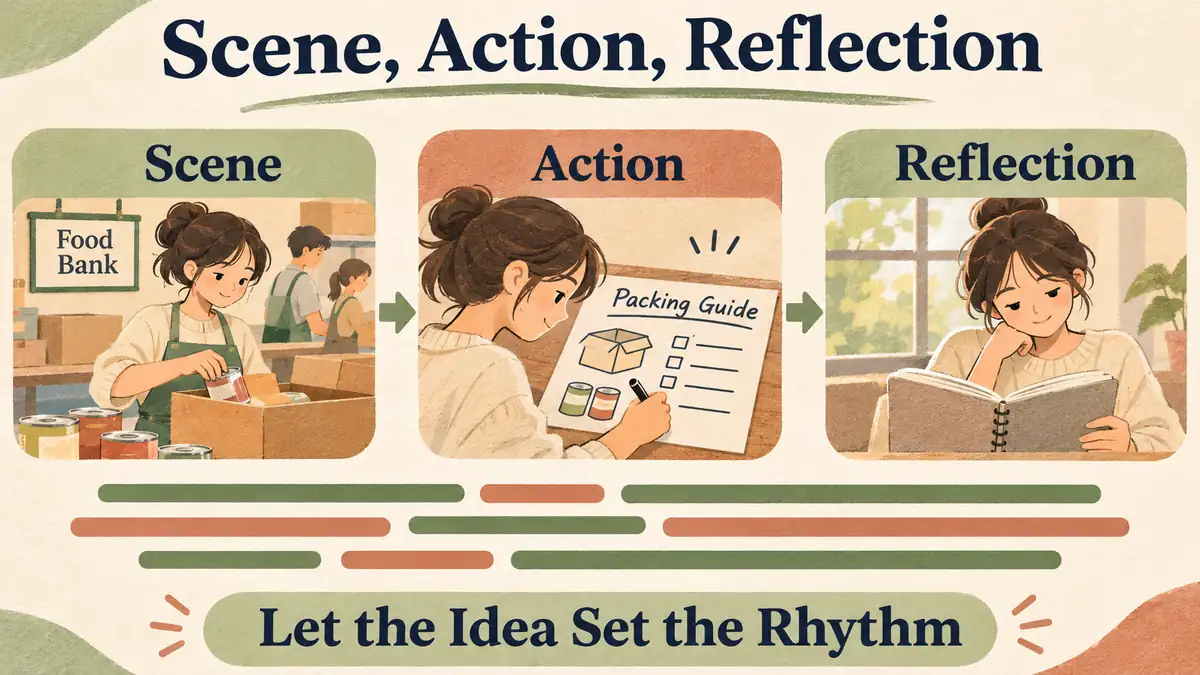
Broad draft: “Volunteering taught me the importance of communication and helped me become a more effective leader.”
Specific revision: “At the food bank, I kept repeating the instructions. Then I drew a packing guide. New volunteers stopped asking where each item belonged.”
The revision replaces a judgment with an observable sequence. In your essay, use only details you remember and can support, then explain their significance.
Let Sentence Length Follow the Moment
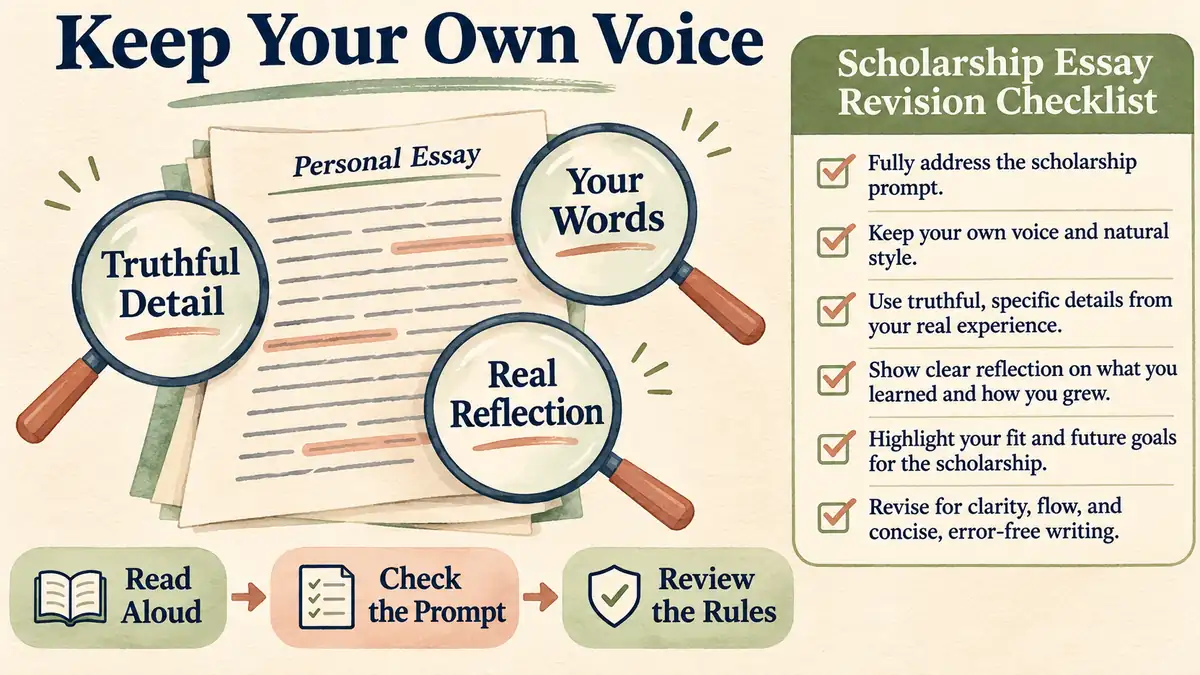
Read the paragraph aloud. If every sentence begins with “I” or runs to the same length, change the structure where the thought benefits.
Slow down at the decision: give the reader enough context to understand the choice.
Shorten the turning point: a brief sentence can emphasize a realization without overstating it.
Connect the reflection: explain how the experience affects a current goal, rather than adding a generic lesson.
Do not alternate long and short sentences mechanically. An abrupt sentence that adds no meaning is still unnecessary.
For broader application structure, the guide to scholarship essay examples provides context. Here, concentrate on revising the story already in your draft.
If the paragraph feels crowded, remove a second anecdote before cutting the detail that makes the first one understandable. One clear moment often carries more weight.
Keep the prompt beside the draft. A vivid story still needs to answer the scholarship's question and fit its stated word limit.
Keep Outside Help Within the Application Rules
Scholarship policies differ. Knight-Hennessy Scholars, for example, permits limited supportive uses but prohibits AI rewriting that replaces or substantially refines an applicant's voice.
Check the actual program's current rules. Where substantive rewriting is prohibited, revise manually; a disclosure does not make a prohibited use acceptable.
If your program expressly permits wording assistance, treat suggestions from Dr. Humanizer as options to inspect, never as replacement experiences or reflections.
The tool cannot establish what happened in your life. Compare any suggested wording with your original account before deciding whether to keep it.
Facts: preserve dates, responsibilities, outcomes, and other people's roles.
Voice: remove words you would not comfortably use or explain.
Meaning: retain uncertainty and avoid turning a small contribution into sole responsibility.
Ownership: keep your original draft and any records the application requires.
Ask a trusted reader where the story becomes unclear. Feedback on clarity can help you decide what to revise without handing over the writing.
FAQ
Should I Make the Essay Sound More Academic?
Use the language the story needs. Clear, precise wording usually serves a personal account better than technical vocabulary added only to sound impressive.
What If My Experience Seems Too Ordinary?
Focus on a real choice and its consequences. A small responsibility explained thoughtfully can reveal more than a dramatic event described vaguely.
Can I Use a Detector Score to Judge My Voice?
No. A score cannot verify your memories, ownership, or compliance with an application policy. Review those questions directly.
Conclusion
Keep one truthful scene, one understandable decision, and a reflection you can explain. Revise rhythm around those elements, then check the prompt and assistance rules.