

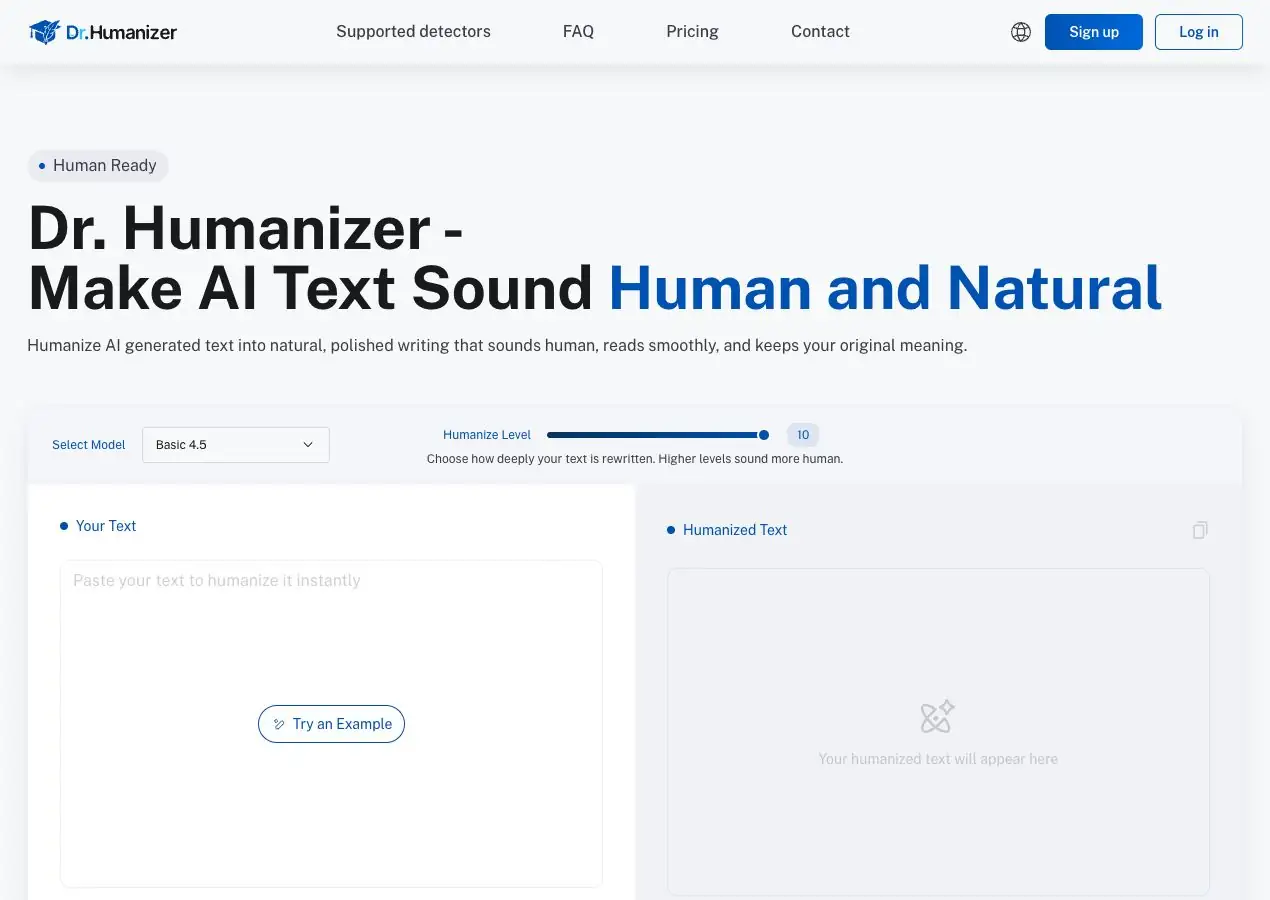
Dr. Humanizer and GenZWrite frame editing in different ways. Dr. Humanizer's public page presents model selection and a Humanize Level control, alongside a description of alternative rewrites. GenZWrite describes voice and task modes, including academic and social uses. These differences matter when you need to choose an appropriate register, decide how extensive an edit should be, and retain responsibility for the final wording.
This comparison examines public interfaces and product descriptions reviewed on November 12, 2026. It is not a head-to-head output test. No speed, accuracy, meaning-preservation, or detector-performance winner is inferred from either product's marketing. The useful decision is which workflow fits the writing task you are allowed to complete.

Begin with the writing situation, not the tone label
A literature review, a discussion-board reply, and a social post may concern the same topic but need different language. The literature review must preserve attribution and qualified claims. The reply may address a classmate directly. The social post may prioritize a concise opening. “More natural” does not describe one style that works equally well for all three.
Before choosing a tool or mode, write a short editing brief. Identify the audience, the purpose of the passage, the expected level of formality, and the features that must stay fixed. For an academic paragraph, these might include a technical term, a contrast between two studies, and the citation attached to each claim.
Then define one change you actually want. “Make the reason for this contrast easier to follow” is more useful than “make it sound human.” It gives you a standard for accepting or rejecting a rewrite even when the product's settings use broad labels.
How the two products present editing choices
The visible workflow on Dr. Humanizer centers on supplying text and choosing a rewriting level and model. Its homepage also describes three alternative rewrites. Those are product-described options; they do not establish that every account, passage, or session will produce the same experience.
GenZWrite's homepage describes Academic, Social, DM, and Hustle uses, and its instructions also refer to named voice or mode choices. This positions task and audience selection prominently in its product messaging. Because the page uses several sets of labels, verify the choices available in your current session rather than assuming every advertised mode appears in one selector.
The distinction is between how the products describe control, not a measured difference in their outputs. A rewriting-level setting suggests how extensively wording may change. A task-mode label suggests an intended audience or use. Neither tells you, by itself, whether a particular sentence is appropriate for your assignment.
Decision | Dr. Humanizer's public presentation | GenZWrite's public presentation | What to verify yourself |
|---|---|---|---|
Editing depth | Humanize Level and model selection | Mode- and task-oriented rewriting descriptions | Which kinds of wording and structure actually change |
Register | Natural, polished rewriting | Academic and other audience-oriented uses | Whether the result matches the assignment's register |
Choosing wording | Describes multiple rewrite alternatives | Describes styles and writing situations | Whether the available output gives you useful choices |
Final control | Human review remains necessary | Human review remains necessary | Whether you can reject or manually revise each change |
Editing depth is about the change, not its size
A deep edit can improve a paragraph by reorganizing its reasoning. It can also remove a contrast or move a citation away from the statement it supports. A light edit may preserve the structure but fail to resolve a confusing relationship. Judge the change by its effect, not by how different the output looks.
Illustrative example—not output from either product:
Original: “Although both studies examined commuter students, only the second measured travel time directly, so their findings are not interchangeable.”
A useful revision would make the methodological distinction easier to follow while retaining “both,” “only,” and the reason the findings differ. A shorter version such as “Both studies found that travel time matters” introduces a claim the original does not make.
For this passage, tone is secondary to the contrast between the studies. A setting marketed for student voice cannot decide which parts of that contrast are essential. That judgment comes from your reading of the sources.
Tone selection needs an academic register check
A task label is a starting point for review. Even within academic writing, a reflective journal and a methods section do different jobs. Plain wording can help either, but the journal may permit personal reflection while the methods section needs a reproducible account of a procedure.
After any revision, check the following:
Audience: Does the passage assume the same level of subject knowledge?
Certainty: Are words such as “may,” “suggests,” and “under these conditions” still doing their original work?
Attribution: Can readers still tell whose evidence or interpretation is being discussed?
Voice: Is the sentence consistent with the surrounding paper, rather than sounding like a different writer?
For a social post about the same research, you may choose a different opening or shorten context. That is an adaptation for a new audience, not proof that the academic version needed a more casual tone. Keep the original academic paragraph so the two tasks do not become mixed.

What meaningful user control looks like
Control includes selecting a setting, but it also includes deciding what never enters the tool and what never enters the final paper. You should be able to keep an accurate sentence, reject an attractive but misleading phrase, and document the assistance when required.
Use a small, permitted sample before processing a long draft. Save the original, note the settings you selected, and compare each proposed change with your editing brief. Do not change several settings at once if you want to understand which choice affected the result. Record observations in ordinary language: “the revision removed a qualification” is more informative than an unsupported claim that a tool is accurate or inaccurate overall.
When reviewing alternatives, evaluate complete sentences and their connections. Combining fragments from different versions can introduce a disagreement in tense, reference, or logic even if each fragment reads smoothly alone. Read the reconstructed paragraph from beginning to end before accepting it.
Choose for the task you can evaluate
If your main need is to compare alternative wording for one carefully defined passage, investigate the rewrite choices available in your Dr. Humanizer session. If you regularly adapt writing for different audiences, investigate how GenZWrite's available task or voice choices fit those situations. In both cases, check the actual current controls and keep a manual review step.
Neither public description establishes a universal recommendation. Account access, available functions, and your institution's policy may constrain the choice. This article does not compare paid plans or measured outputs, so it cannot establish a price winner or a more reliable product.
The broader distinction between a humanizer and a paraphraser can help clarify your editing goal. For a scientific passage, apply the same scientific writing standards regardless of which service suggested the wording.
FAQ
Does an Academic mode make a rewrite acceptable for coursework?
No mode grants permission. Check the assignment's rules and ask the instructor if the boundary is unclear. Academic suitability also requires accurate reasoning, appropriate attribution, and a register that fits the specific task.
Is stronger rewriting better for awkward prose?
Not necessarily. First identify the problem: an overloaded sentence, an unclear reference, or missing reasoning. A focused manual change may solve it. More extensive rewriting creates more material to verify and is useful only if it improves the actual problem.
Can I use a detector score to choose between the tools?
A score does not directly measure whether the revision preserved your meaning, evidence, or voice. Evaluate those qualities against the source paragraph. Neither this comparison nor the products' public claims establishes a guaranteed detection outcome.
Conclusion
Compare Dr. Humanizer and GenZWrite through the editing decisions you need to make: extent of change, audience, register, and the ability to review and reject wording. Public controls can help you choose a workflow, but the final standard is a passage that fits its purpose and still says exactly what the evidence supports.