

To humanize a lab report, revise the language that explains the experiment while keeping the experiment itself unchanged. Shorten cumbersome sentences, name the action clearly, and connect results to the question you investigated. Preserve every measurement, unit, procedural detail, uncertainty statement, and reference that a reader needs to evaluate the work.
Natural scientific writing is precise and easy to follow. It does not need slang, dramatic language, or a personal story. A report can sound less mechanical without becoming less technical, provided you separate wording decisions from factual decisions before editing.

Start with a record of what must stay fixed
Keep your lab notebook, calculation file, and current report together. Save a copy of the draft before changing it. Then identify the information that the revision must preserve: sample identity, quantities, equipment settings, sequence of operations, observations, exclusions, and the meaning of any uncertainty you report.
Pay attention to relationships as well as numbers. “Three samples were measured twice” describes a different design from “two samples were measured three times.” The total number of measurements may be identical, but the experiment is not. Similarly, a range, standard deviation, standard error, and instrument resolution cannot be substituted for one another to make a sentence shorter.
This is a narrower task than learning general scientific writing principles. You are auditing how one report represents one experiment, including the details that make its methods and results interpretable.
Revise methods around actions and conditions
Methods become difficult to read when the main action is buried inside phrases such as “the carrying out of the measurement.” Name what happened, then state the conditions required to understand or repeat it. Keep the procedure in its actual order, including waiting periods and preparation steps.
Illustrative example—not a real experiment:
Before: “Following the completion of the heating process, the taking of temperature readings was conducted at intervals of 30 s.”
Revised: “After heating, we recorded the temperature every 30 s.”
The revision is appropriate only if the original procedure involved the authors recording those readings after heating. If a sensor logged the values automatically, say that instead. A smoother sentence should not silently change who or what performed an action.
Keep material names specific. Do not replace “deionized water” with “water” or “mass” with “weight” just to avoid repetition. Technical repetition can be useful when it prevents ambiguity. Follow your course's convention on first person and tense rather than forcing every method into the same grammatical pattern.
Improve results without rounding away the evidence
Give each results paragraph one clear job: identify an observation, direct the reader to the relevant figure or table, and explain the comparison being reported. Remove sentences that repeat an entire table without helping readers notice a meaningful pattern.
Check the revised paragraph against the underlying data, not against your memory of the experiment. Preserve signs, decimal places, denominators, sample sizes, and units. “Increased by 5%” and “increased by five percentage points” describe different changes. “No difference was detected” also makes a more limited claim than “the groups were identical.”
Illustrative example: “The measured concentration was 2.40 mg/L, compared with 2.10 mg/L in the control.” A stylistic revision may make that comparison easier to read. It must not turn it into a percentage increase unless you calculate that percentage correctly, decide it is useful, and document the change as an analytical addition rather than a wording adjustment.
Keep uncertainty attached to the right result
Uncertainty belongs to the measurement or estimate it qualifies. Moving it to a distant sentence can make the result look more exact than it is. Preserve the explanation of what the uncertainty represents and how it was obtained.
For an illustrative value written as “10.2 ± 0.3 cm,” do not remove the uncertainty because the shorter version reads more cleanly. Do not relabel that interval as a confidence interval unless your analysis supports that description. If the original report is unclear about the notation, resolve the scientific question before polishing the sentence.
The same rule applies to limitations. “The observation is consistent with the predicted relationship” should not become “the experiment proves the theory.” Keep distinctions between an observation, an interpretation, and a possible explanation visible throughout the discussion.
Use transitions that explain the reasoning
Transitions should tell the reader why one result leads to the next point. Replace repeated phrases such as “Furthermore” with a more informative connection when needed: “To examine whether temperature affected this pattern, we compared the two conditions.”
That sentence is suitable only if the comparison was actually made. Do not invent an additional analysis to create a more elegant narrative. If a result was unexpected, explain the discrepancy using available evidence and acknowledge what remains uncertain. Avoid presenting an untested explanation as the established cause.
In the discussion, keep each citation beside the claim it supports. A general source about a method may not support your particular result. The broader research paper drafting process can help organize an argument, but the lab report still needs to distinguish your measurements from findings in the literature.
If you use a rewriting tool, limit its job
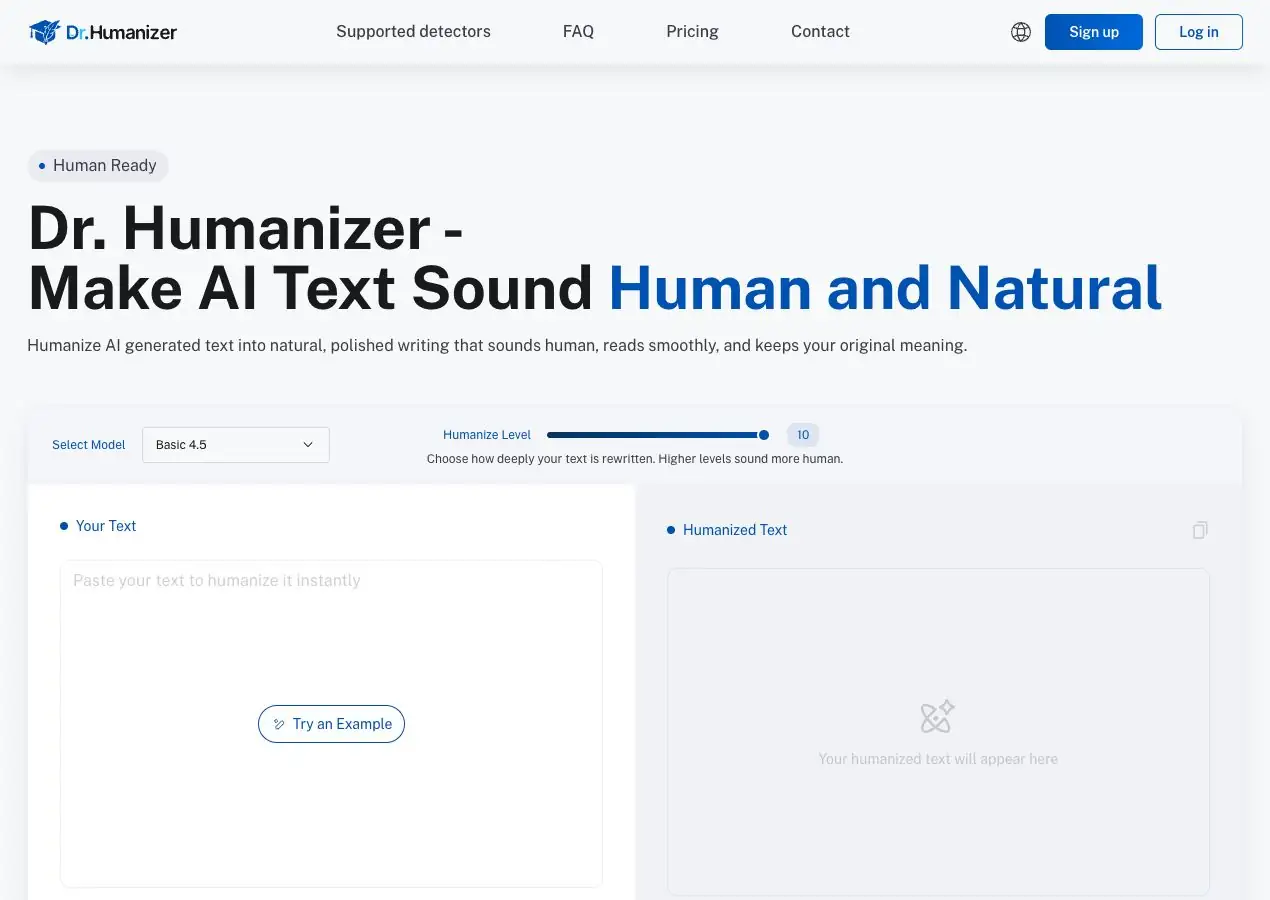
Where your course permits language assistance, Dr. Humanizer can be considered as one source of alternative wording. Start with a short passage whose meaning you understand, keep the original beside it, and review proposed changes yourself. A rewrite is not a verification of your procedure, calculations, or conclusions.
Do not submit confidential research, identifiable participant information, or restricted course materials to a service without permission. Record any assistance your course requires you to disclose. If no permitted tool setting preserves a crucial term, keep the original term and edit the surrounding prose manually.
Finish with a separate accuracy pass
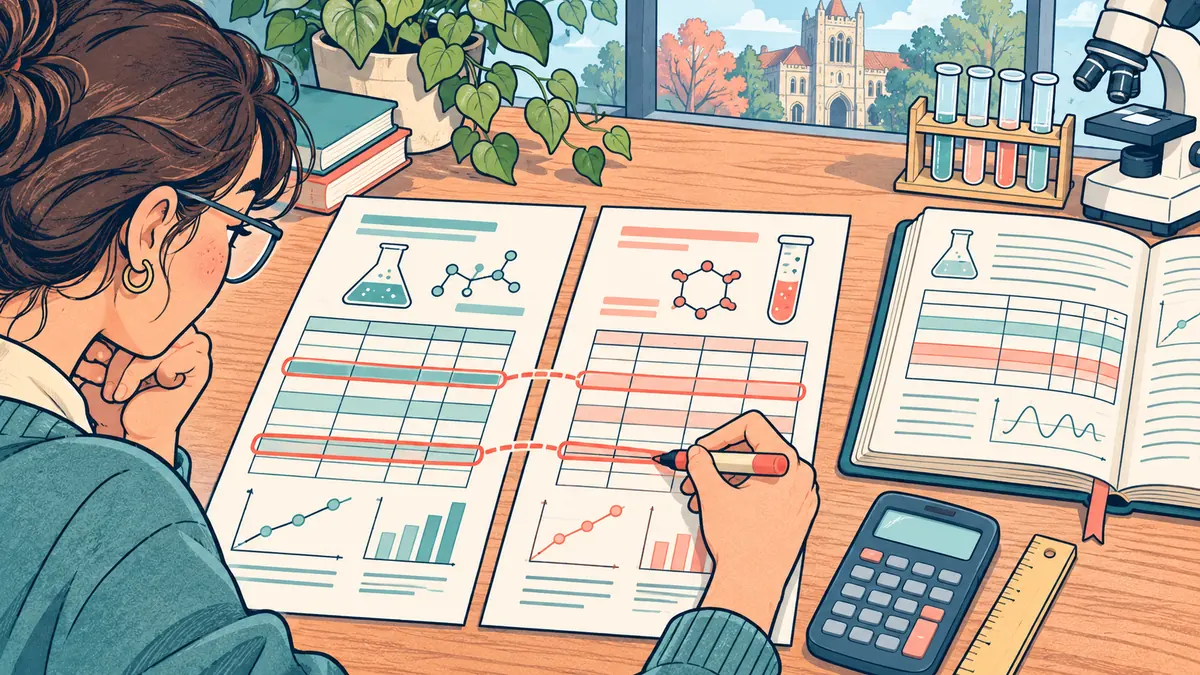
Read for flow first, then stop assessing style and compare the revised report with the source records. Use a simple change log with the original sentence, revised sentence, reason, and scientific information checked.
Confirm that every figure reference still points to the correct figure, every unit matches the data table, and every limitation remains in place. Check equations and symbols separately from prose; an apparently minor formatting change can alter their interpretation. Finally, read the abstract and conclusion against the revised results so the report makes the same claim in all three places.
FAQ
Should I replace technical terms with everyday words?
Only when the substitute has the same meaning and suits the audience. Define an unfamiliar term if necessary, but keep established names for methods, materials, and measured quantities. Familiar wording is not automatically more accurate.
Can I remove a procedural detail that interrupts the sentence?
Move it to a clearer sentence if it is needed to understand or repeat the experiment. Remove it only after deciding that it is irrelevant under the assignment requirements, rather than treating deletion as a purely stylistic choice.
Should a lab report sound like my everyday conversation?
It should sound like a clear explanation you can defend. Scientific register, the course rubric, and the needs of the reader matter more than a conversational tone. You can write directly without making the report informal.
Conclusion
Humanize a lab report by making the experiment easier to understand. Lock the scientific record, revise actions and reasoning, and then audit numbers, units, uncertainty, and citations independently of style. Keep a change only when the wording improves and the underlying account of the experiment remains accurate.