

AI-generated writing can be useful but unusually uniform.
It may have clean grammar, steady rhythm, and broad wording that does not sound like a real writer working through a specific task.
Understanding the humanizing process helps you decide when the tool is useful and when deeper revision is still needed.
Quick Answer to How Does an AI Humanizer Work?
An AI humanizer works by rewriting AI-generated or AI-assisted text to sound more natural, varied, and reader-friendly. It may change sentence rhythm, replace predictable phrases, adjust tone, simplify formal wording, and offer alternative versions. A humanizer does not automatically verify facts, create original research, or make a submission acceptable under every course policy. Students should use it as an editing aid only when allowed, then review the final text for accuracy, citations, and their own voice.
It Detects Patterns in Robotic-Sounding Prose
Humanizers usually begin by reading the input for features that make writing feel machine-like. Those features may include repeated sentence structures, formal filler, vague transitions, and broad claims that do not point to evidence.
The tool does not understand your class the way you do. It identifies language patterns and suggests rewrites. That can be helpful when a paragraph is stiff, but it cannot tell whether a claim belongs in your essay or whether a source is credible.
Students should treat the first output as a draft of a draft. The tool can show possibilities, but the writer decides what stays.
That decision should be based on purpose. If a rewrite sounds warmer but weakens the main claim, the original idea needs a better edit rather than a softer sentence.
It Rewrites Tone, Flow, and Sentence Variety
The most visible change is style. A humanizer may shorten long sentences, combine choppy ones, replace abstract wording, and vary transitions. It may also make a paragraph sound less like a formal summary and more like practical explanation.
Humanizer Change | Possible Benefit | Student Check |
|---|---|---|
Varies sentence length | Improves rhythm | Does the emphasis still make sense? |
Replaces predictable phrases | Reduces stiffness | Did the meaning change? |
Simplifies formal wording | Makes the paragraph easier to read | Are key academic terms still accurate? |
These changes can improve readability, especially for AI-assisted brainstorming notes. They should not erase important terms, citations, or discipline-specific language.
The voice in scholarship essay samples differs from that of a biology lab report or a history essay. Humanizing works best when the writer chooses the version that fits the genre.
It May Produce Several Rewrites for Comparison
Some humanizers give more than one version of the same passage. That can help writers compare tone, clarity, and structure. A student might prefer one sentence from version A and another from version B.
Dr. Humanizer, for instance, supports multiple rewriting models and provides 3 rewrites so users can compare, choose, or combine sentences. That kind of comparison can be useful when you are editing for flow rather than accepting a single output automatically.
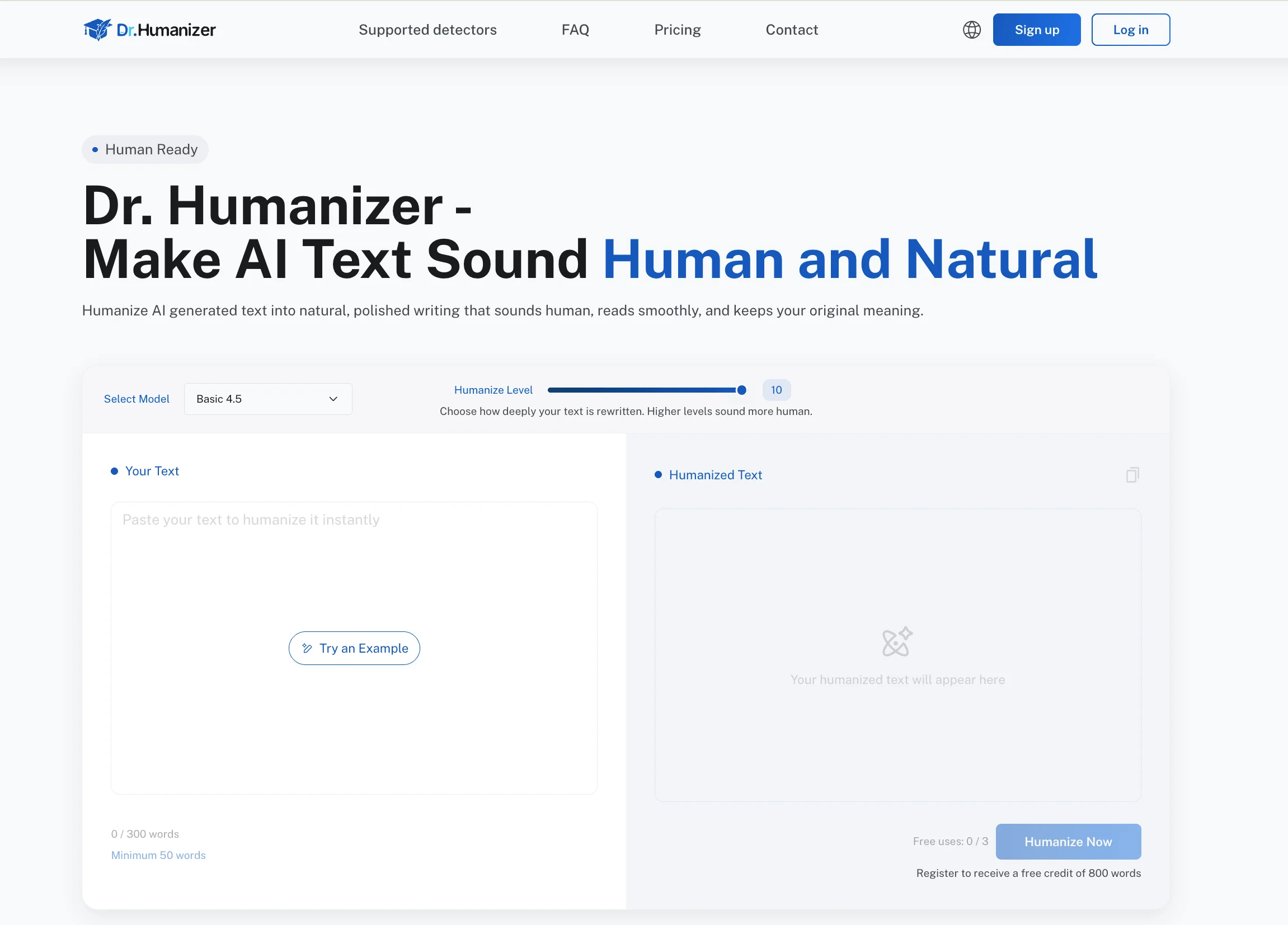
The comparison step is where human judgment matters most. Choose the version that best preserves your meaning and meets the assignment's expectations.
For students, the workflow for humanizing AI drafts should be slow enough to notice changes. Read the original, read the rewrite, then mark any sentence where the emphasis shifted. If the tool made the sentence easier to read but less accurate, revise it yourself.
It Does Not Replace Fact-Checking or Citation Work
A humanizer changes wording; it does not make unsupported material true. If the original AI text invented a source, overstated a study, or misunderstood a concept, a smoother rewrite can hide the problem rather than fix it.
Cornell's ethical AI guidance encourages critical evaluation of AI outputs, including accuracy and reliability. That applies directly to humanized writing. Before using a rewritten paragraph, verify names, dates, claims, quotations, and references.
For academic writing, also check whether the revised sentence still supports your essay's thesis statement. Sometimes a style tool softens a claim so much that it no longer does the work your argument needs.
It Cannot Guarantee AI Detector Results
Whether humanizers bypass AI detectors is uncertain. A rewrite may reduce patterns some tools associate with AI writing. Another detector may still flag the text, or a teacher may notice a mismatch between the paragraph and your usual work.
Turnitin's AI writing release notes mention likely AI-paraphrased text as a reporting category and also acknowledge false positives. That combination is a reminder that detector scores are imperfect and that humanized text is not automatically safe.
Use a humanizer for clarity when the assignment permits it. Do not treat it as proof that a paper will pass review.
If your school asks for disclosure of AI assistance, include the humanizer in that disclosure. Honest documentation is easier than explaining hidden tool use after a concern appears.
Writers should also compare the rewrite with their normal voice. If the tool makes every sentence sound like marketing copy or removes the careful uncertainty needed in academic work, the paragraph needs a quieter manual edit.
Key Takeaways
An AI humanizer rewrites style, tone, and rhythm to make text sound more natural.
It can help with readability but cannot verify facts or create original reasoning.
Multiple rewrites are useful only when the writer compares them carefully.
Detector outcomes remain uncertain, especially as tools and models change.
Students should use humanizers only within course rules and review the final text themselves.
FAQ
Is an AI Humanizer the Same as a Paraphraser?
No. A paraphraser mainly rewords text, while a humanizer focuses on making AI-assisted writing sound more natural and less robotic. The two functions can overlap, but their goals are not identical.
Can a Humanizer Improve My Own Writing?
Yes, if you use it as an editing suggestion. It can help you see smoother phrasing or better rhythm. You should still keep your meaning, examples, and citations under your control.
Does a Humanizer Know My Assignment Rules?
No. A tool does not know your course policy unless you provide details, and even then it cannot decide what your instructor permits. Check the syllabus or ask your instructor before using AI editing.
Will Humanized AI Text Sound Exactly Like Me?
Not automatically. Some tools can imitate style, but your voice comes from your choices, evidence, and explanation. Review the output so it matches how you would actually write and speak about the topic.
Conclusion
How does an AI humanizer work? It rewrites patterns in AI-assisted text so the result can sound more natural, varied, and readable.
That can be useful, but it is only one part of revision. The writer still has to check facts, cite sources, follow policy, and make sure the final paragraph reflects real understanding.