

For a long academic draft, the useful Dr. Humanizer vs GPTHuman comparison is about what happens across sections: how much text a request can handle, what must stay consistent between requests, and how you check that a rewrite retains the argument. A larger word allowance reduces some interruptions, but it does not prove better meaning retention.
This comparison reviews public product information available on November 13, 2026. It is not a head-to-head output test. The examples and review criteria below are an editorial evaluation method, not measured results from either product. Use either service only within the rules that apply to your assignment or publication.
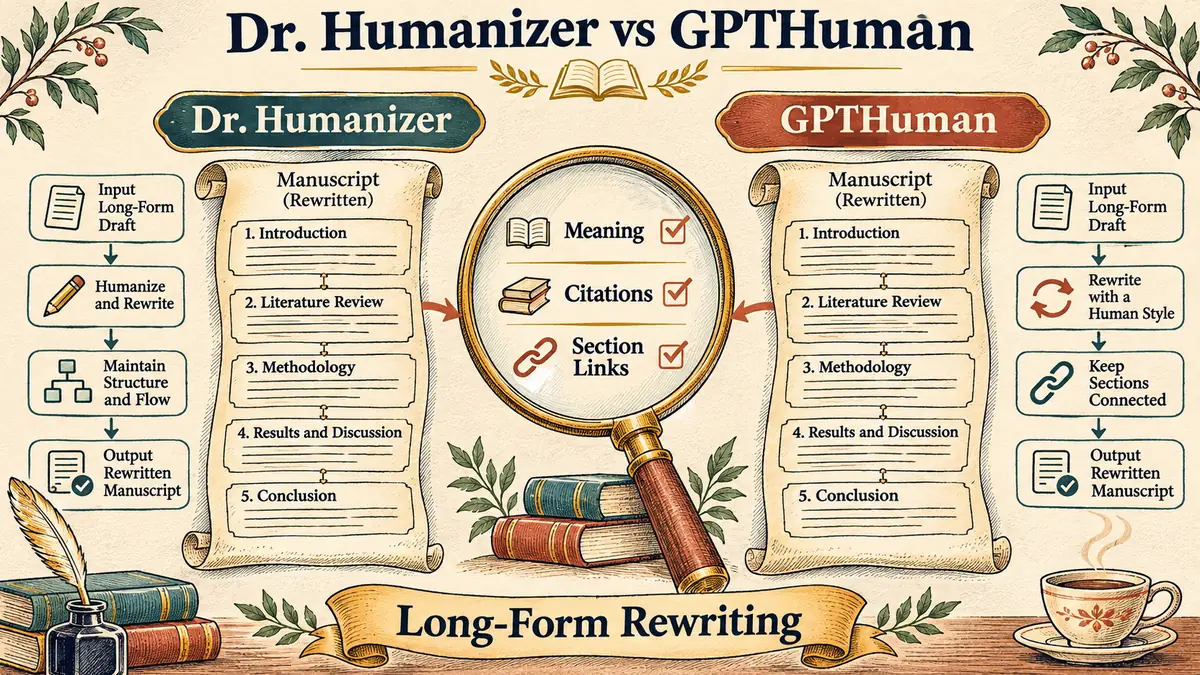
Workflow comparison and review criteria; not measured product results.
Compare the Published Long-Form Workflow
Dr. Humanizer advertises rewriting up to 5,000 words and presents a Humanize Level control. Its homepage also describes three rewrite alternatives. The public workspace inspected for this article displayed a smaller allowance for that session, so an advertised capacity should not be assumed to apply to every account or free request.
GPTHuman's public pricing page separates monthly allowance from words per output. It lists 300 words for the free output, 1,000 for Starter, 1,500 for Plus, and 2,500 for Unlimited. Its help documentation recommends dividing long documents into sections that fit the account limit and describes tone and mode choices. Check the current account screen before processing a complete draft.
Decision | Dr. Humanizer | GPTHuman |
|---|---|---|
Long-form capacity | Homepage advertises up to 5,000 words; session allowances may differ. | Pricing specifies different words-per-output limits by plan. |
Editing choices | Public workspace presents model selection and Humanize Level. | Help documentation describes tone and mode selection. |
Long document handling | Check the actual input allowance before deciding how to divide the draft. | Help advises section-sized requests within the plan limit. |
Meaning retention | Must be checked against the original and sources. | Must be checked against the original and sources. |
The table compares disclosed workflow features, not quality scores. Neither a word limit nor a mode name establishes which output will preserve a particular qualification or citation. Product claims about detection performance do not replace an academic accuracy review.
Separate Three Different Kinds of Limits
Per-Request or Per-Output Capacity
This limit affects whether you can process a section in one operation. Read the wording carefully: an input limit and an output limit are not necessarily the same thing. A draft near the boundary may expand during revision. Keep the original section intact so you can see whether the result ends early or omits material.
Total Account Allowance
A monthly allowance concerns aggregate usage. It does not mean one request can contain that many words. Repeated attempts can consume allowance without solving the underlying writing problem. Before trying another rewrite, identify the specific defect you want corrected and whether a manual edit would resolve it.
Your Review Capacity
The largest request you can submit may be larger than the passage you can check responsibly. A dense methods section with many quantities takes different effort from a general introduction. Choose a reviewable unit based on its argument and evidence, not just the number displayed beside the text box.
Build a Meaning Record Before Rewriting
A long document contains dependencies that a sentence-level review can miss. An abbreviation may be defined in the introduction, a limitation may qualify several later claims, and a term may refer to the same measure throughout the paper. Record these dependencies before sending any permitted passage to a tool.
Central claim: what the paper argues, including the limits of that argument.
Fixed terminology: definitions, variable names, abbreviations, and distinctions that must remain stable.
Evidence anchors: numbers, units, quotations, citations, and the claims each supports.
Section purpose: what each section contributes and what its final paragraph prepares the reader to understand next.
This record is for your review. Do not assume either product provides a lock that enforces every item. If the interface does not support an instruction or protected element, keep sensitive or exact material outside the rewrite and integrate it manually after checking the surrounding prose.
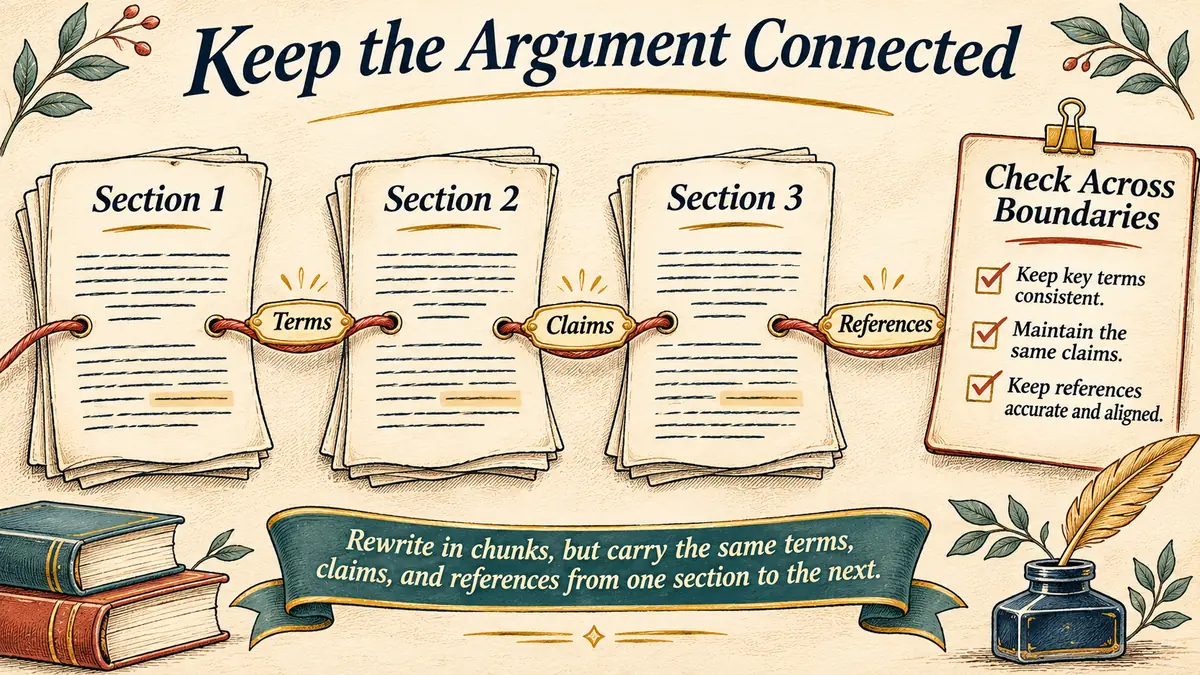
Check the Handoff Between Rewritten Sections
When a draft must be divided, end a request at a coherent boundary rather than halfway through a claim. Save sections in order and keep each version clearly labeled. After reviewing the individual outputs, read the final paragraph of one section together with the first paragraph of the next.
Illustrative example, not product output: an earlier section states that a relationship was observed only among first-year participants. A later section originally says, “Within that group, the pattern remained consistent.” If a rewrite changes the later sentence to “The pattern was consistent among students,” the limitation has disappeared even though the sentence reads smoothly.
The repair is not simply to restore the word “group.” Confirm that readers can identify the group without returning several pages, then write the limitation explicitly where needed. The same handoff check applies to abbreviations, study names, and distinctions between an observed association and a causal conclusion.
Across-Section Check | What a Problem Looks Like | Acceptance Standard |
|---|---|---|
Terminology | One measure receives two names that imply different concepts. | The same concept uses the established term consistently. |
Qualification | A later claim loses an earlier population or setting limit. | The scope remains explicit wherever it matters. |
Continuity | Both sections introduce the same point, or neither explains the transition. | The combined draft advances the argument without gaps. |
Attribution | A source citation moves away from the claim it supports. | Every source-based claim remains traceable. |
Run a Fair Comparison on a Passage You Can Evaluate
Select the same permitted passage. Use writing you are authorized to submit, with no confidential material. Include a genuine transition or qualification so the task reflects your needs.
Define the requested improvement. For example, clarify an overloaded paragraph while preserving its technical terms and source relationships.
Record the available settings. Note the date, account allowance, and choices used. Do not assume similarly named settings are equivalent across products.
Compare against the source. Check omissions, added assertions, altered numbers, and changed levels of certainty before judging style.
Assess the manual work left. Record which repairs are required and whether the final wording fits the surrounding paper.
Describe observations narrowly. “This version dropped the limitation in paragraph two” is supportable if you can show the change. “This product cannot preserve meaning” is a much broader claim that one passage cannot establish. Do not turn a single detector score into a quality ranking.
Choose for the Document You Actually Have
If your main issue is handling a coherent section with fewer interruptions, inspect the usable allowance in your Dr. Humanizer session and compare it with the relevant GPTHuman plan limit. If the document must be divided under either option, prioritize the section-handoff review rather than treating the split itself as a failure.
If the draft is technically dense, choose the workflow that leaves you able to trace every important change. A smaller, carefully reviewed passage may serve the paper better than a complete rewrite that you cannot check. For scientific work, apply consistent scientific writing standards regardless of which tool suggested the wording.
The final choice also depends on permitted assistance. Keep an accurate account of the work performed and follow the relevant AI-use disclosure requirements. The tool's availability does not determine what a course or journal allows.
FAQ
Does a Larger Word Limit Mean Better Meaning Retention?
No. Capacity describes how much text the product accepts or returns under specified conditions. Meaning retention requires comparison with the original claims, evidence, and connections.
Should I Rewrite the Entire Paper Again After One Bad Section?
First identify the local problem. Repair or rework the affected passage, then check its connections to neighboring sections. A complete second rewrite creates more material to verify and may introduce new changes elsewhere.
Can I Combine Sentences From Different Rewrite Alternatives?
Yes, if permitted, but review the reconstructed paragraph as a new version. Pronouns, terminology, tense, and citation scope may no longer align even when each selected sentence looks acceptable alone.
Conclusion
Compare Dr. Humanizer and GPTHuman through a long document's actual needs: usable request size, coherent section boundaries, and the work required to verify meaning. Preserve a source version, track cross-section dependencies, and select wording you can defend against the evidence. Public feature descriptions help plan the workflow; they do not establish an output-quality winner.