

An AI score can feel like a judgment, even when the report is only a signal.
That pressure can push writers toward quick rewrites that do not actually improve the paper.
A safer approach is to revise the causes of concern while protecting academic integrity and keeping your work explainable.
Quick Answer to How to Lower AI Detection Scores
To lower AI detection scores responsibly, revise the text so it shows your own authorship: add specific evidence, remove generic AI phrasing, vary sentence rhythm naturally, verify facts, and follow your course AI policy. Do not chase a perfect score or trust tools that promise certain detector outcomes. AI detectors can produce false positives and false negatives, so a lower score should not be the only goal. The stronger goal is a draft you can explain, cite, and defend.
First, Check Whether the Score Matters for Your Class
Not every class uses AI detection in the same way. Some instructors do not use automatic detectors at all. Others use them as one piece of information. Some assignments allow certain AI support and require disclosure.
Read the syllabus and assignment directions before revising around a score. Stanford's student guidance recommends reviewing course policy and asking when AI use is unclear. That can save you from editing in the wrong direction.
If AI tools were not allowed, the issue is not only the score. You may need to restart from your own notes and approved sources.
If AI tools were allowed for limited support, save a note about what you used. That note can help you separate acceptable editing from parts that need your own drafting.
Find the Parts That Sound Generic
Detector scores often send students into whole-paper panic, but the real revision work usually happens sentence by sentence. Look for paragraphs that make broad claims without evidence, use repeated transitions, or sound detached from the assignment.
Replace vague claims with details. Add a quotation, dataset, passage, case, or course term where it belongs. Explain the connection in your own words. These changes make the writing more specific and more useful to the reader.
Do this before changing tone. A paragraph with stronger evidence often sounds more human because it shows the writer making real choices.
Weak: The topic is important in modern society.
Stronger: The policy matters for first-generation students because it changes how advising appointments are scheduled.
Weak: The author uses symbolism effectively.
Stronger: The repeated image of locked doors shows how the narrator's choices narrow in the final chapter.
Adjust Rhythm Without Damaging the Writing
Some students try to lower AI scores by adding awkward phrases, slang, or mistakes. That is a poor strategy. It can make the paper less credible and may create new problems with grading.
Instead, revise rhythm in ways that match meaning. Use a short sentence when the point needs emphasis. Use a longer sentence when you are connecting evidence to interpretation. Combine sentences only when the relationship between ideas is clear.
Revision Move | Use It When | Avoid It When |
|---|---|---|
Shorten a sentence | The main point is buried. | You remove needed context. |
Combine sentences | Two ideas depend on each other. | The result becomes hard to read. |
Replace formal wording | A simpler word is equally precise. | The technical term is required. |
It also helps to revise one paragraph at a time. Whole-document rewriting can blur your argument, while focused revision lets you ask whether each paragraph has a job, a source connection, and a sentence that clearly belongs to you.
Use Source Notes to Prove Authorship
Lowering a score is less important than being able to show how the paper developed. Keep research notes, outline changes, and drafts that show your choices. If a concern comes up, those materials help explain your process.
Cornell's AI academic integrity guidance warns that detection tools cannot provide definitive evidence and recommends deeper inquiry supported by verifiable information. Students can prepare for that kind of review by keeping clear evidence of their work.
This does not mean you need a perfect record. It means your paper should not appear suddenly with no notes, no source trail, and no explanation.
Use Editing Tools Carefully
If AI editing is allowed, a humanizer can help make stiff AI-assisted wording more natural. Dr. Humanizer may help reduce AI-like patterns and improve flow, especially when you compare several rewrites instead of accepting the first one.
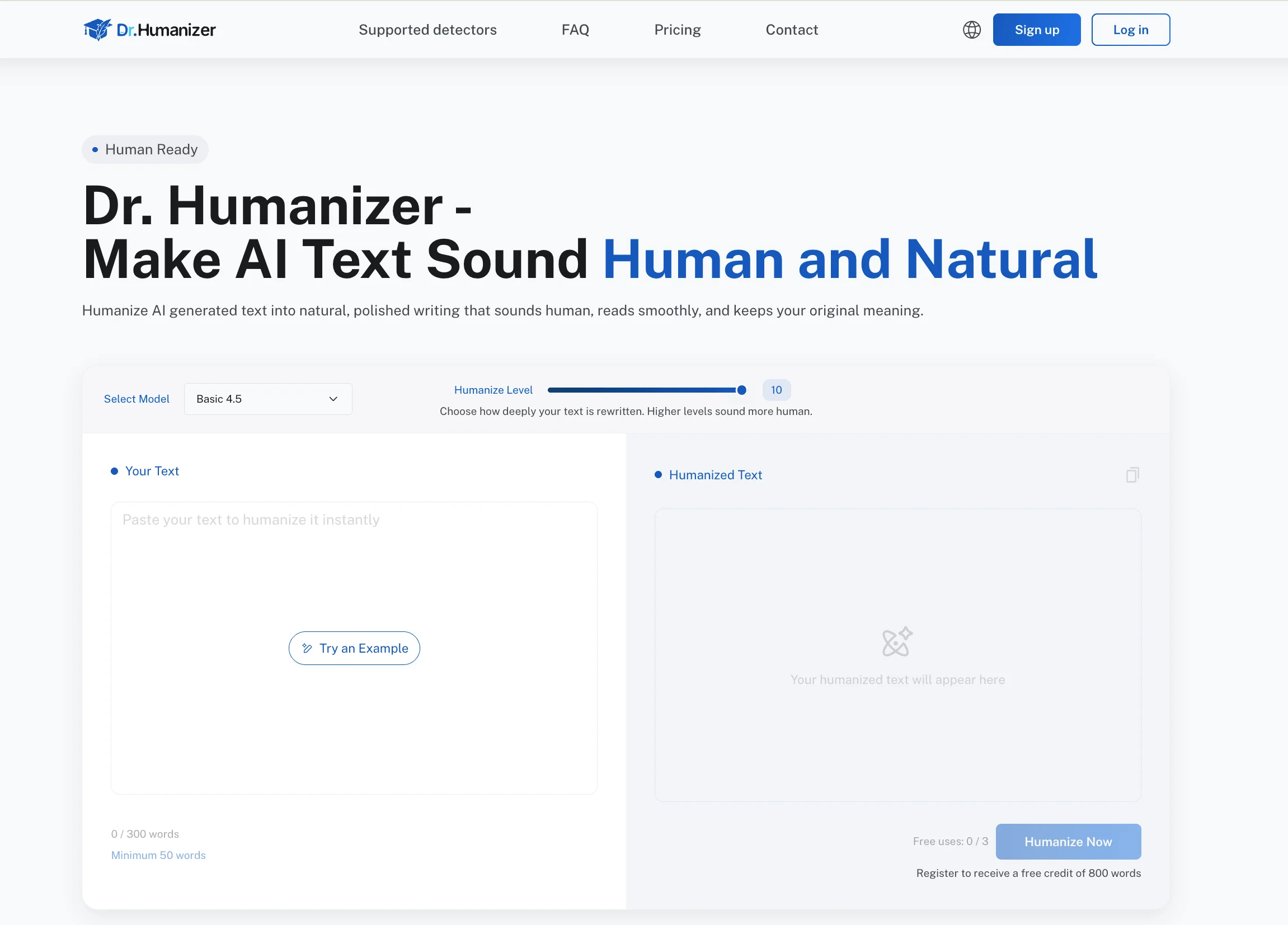
After using any tool, read the draft again. Check whether the revision preserved the evidence, changed a claim, weakened the thesis statement, or introduced a phrase you would not use. The final sentence should still feel like your own decision.
Do not use a humanizer when the assignment bans AI support. A lower score does not make a prohibited process acceptable.
If the assignment allows editing support, keep your revisions transparent. That keeps the focus on clarity instead of secrecy.
After revision, read the draft beside the assignment directions. If the paper now gives clearer evidence, a steadier voice, and a visible connection to your notes, the score has become less central.
Key Takeaways
Responsible score reduction starts with policy, authorship, and evidence.
Generic paragraphs should be revised with specific sources and reasoning.
Sentence variety should improve meaning, not imitate casual imperfection.
Drafts and notes can be more persuasive than detector results.
No tool can promise a safe or guaranteed AI detection score.
FAQ
What Is a Good AI Detection Score?
There is no universal safe score. Schools, tools, and assignments differ, and detector results are not perfect. Focus on following the course policy and producing work you can explain with drafts, notes, and sources.
Can Editing My Own Writing Lower a Score?
It can, especially if the original text was generic or overly polished. More importantly, careful editing can make the paper clearer, more specific, and more connected to your own reasoning.
Should I Rewrite Every Sentence?
No. Rewrite the parts that are unsupported, generic, inaccurate, or unlike your voice. Rewriting every sentence mechanically may create new errors and make the paper less coherent.
Are AI Scores Reliable Enough to Trust?
AI scores can be useful signals, but they are not complete proof. Turnitin and university guidance both emphasize the need for context, evidence, and careful review rather than automatic punishment from a score alone.
Conclusion
How to lower AI detection scores should be handled through stronger writing, not score-chasing. Add evidence, revise generic claims, keep drafts, and make sure the work follows your course rules.
When AI editing is permitted, use it as a support tool and review the final draft yourself. The best outcome is not just a lower number; it is a paper that clearly belongs to you.