

Dr. Humanizer and Mask AI both offer ways to revise AI-assisted prose, but their visible editing controls are not identical. Dr. Humanizer presents model selection and a Humanize Level control, and advertises three alternative rewrites. Mask AI presents Light, Medium, and Aggressive rewrite levels alongside a tone selector. Those differences can help you choose a workflow; they do not establish which tool preserves meaning better.
This Dr Humanizer vs Mask AI comparison focuses on two practical questions: how much control do you have over a revision, and how will you check that it still says what you intended? It is based on the public interfaces and product descriptions reviewed on November 11, 2026, not a head-to-head output test. No detector scores or quality rankings are inferred from marketing claims.

Compare the Controls Before Comparing the Claims
A rewriting control is useful when it lets you make a deliberate editing decision. It is not proof that the resulting sentence is accurate. Start by separating what you can select from what you must inspect afterward.
Review question | Dr. Humanizer | Mask AI |
|---|---|---|
How is rewriting directed? | The public editor shows a model selector and a Humanize Level control. | The public editor shows Light, Medium, and Aggressive choices, plus a tone selector. |
What comparison workflow is described? | The homepage describes three rewrites that the user can compare or combine. | The homepage describes comparing the rewritten text with the original and making further edits. |
What does meaning preservation require? | Manual checking of the chosen wording against the original claims and sources. | The same manual checking, regardless of the selected rewrite level. |
What is not established here? | Measured accuracy, output consistency, and performance on your assignment. | The same outcomes remain untested in this comparison. |
Neither a larger number of controls nor a more forceful setting is automatically better. A student polishing a short explanation may need one small change. A paragraph with an unclear argument needs substantive revision before any style tool becomes useful.
Dr. Humanizer: Reviewing Alternative Wording
The homepage of Dr. Humanizer emphasizes alternative rewrites. That makes comparison a useful way to approach the tool: identify a specific readability problem, inspect the alternatives, and choose only wording that fixes the problem without changing the claim.
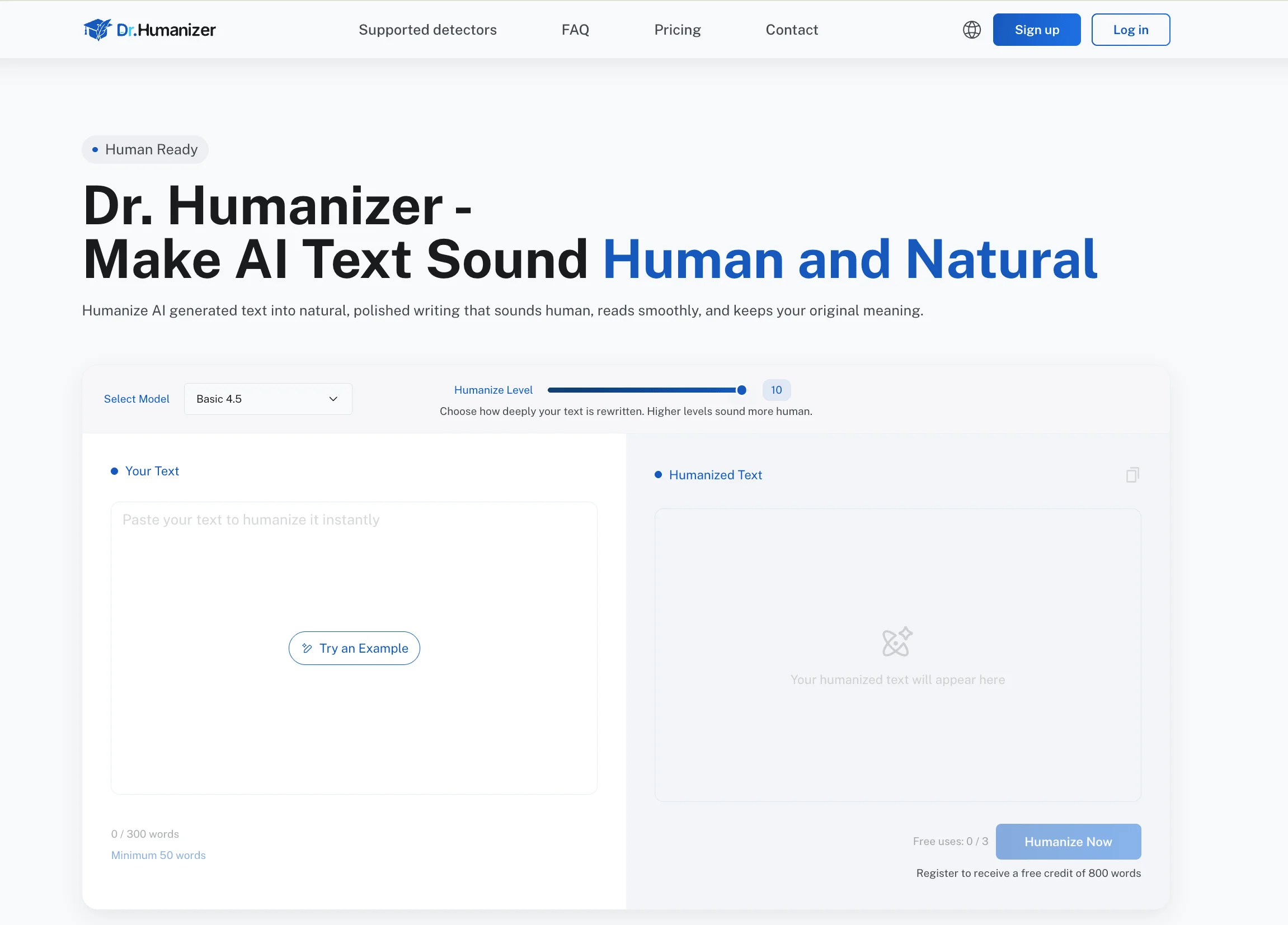
For example, you might want to remove an unnecessarily long introductory phrase while keeping the technical vocabulary in the rest of the sentence. A good result would make the point easier to follow without broadening its scope. If none of the alternatives does that, keep your original wording or edit manually.
The homepage also describes preserving ideas, data, and citations. Treat that as a product claim, not a substitute for checking your paragraph. The existence of several versions does not mean every version will maintain every qualification. Comparing three fluent sentences still requires understanding what each sentence commits you to saying.
For background on the distinction between rewriting and verification, see how an AI humanizer works. Here, the important question is whether the available alternatives help you make a more precise decision.
Mask AI: Choosing a Rewrite Level and Tone
Mask AI's public editor exposes three named rewrite levels and a tone selection control. Its homepage describes a process of pasting a draft, choosing a level, and reviewing the result beside the original. That is a different starting point from focusing primarily on a set of alternative versions.

Use the level as an editing choice, not a quality ranking. If your paragraph already has a clear argument and only one awkward sentence, begin with the least extensive change that addresses the problem. A stronger setting may create more wording to review; it should not be presumed more accurate or more appropriate for academic prose.
The tone label also needs interpretation. A neutral presentation can suit an analytical assignment, but the actual output still needs to preserve your disciplinary terms, degree of certainty, and attribution. A tone control cannot determine whether a statement accurately represents a study you read.
Features and access can differ across account states or change over time. Before committing to a workflow, verify the controls available in your own account. This comparison does not assume that a visible public control establishes a particular paid-plan entitlement.
Define the Meaning That Must Not Change
Before trying either tool, write a short list of facts and relationships the paragraph must preserve. This is more useful than asking whether the rewrite generally sounds similar. Similar-sounding sentences can make different claims.
Who and what: Keep the population, subject, and outcome unchanged.
Numbers and units: Preserve values, denominators, time periods, and measurement units.
Strength of evidence: Do not turn an association into a cause or a possibility into a certainty.
Scope and exceptions: Retain conditions such as “in this sample,” “during the first week,” and “except when.”
Attribution: Keep a source's finding separate from your interpretation of it.
Negation: Check words such as “not,” “no,” and “without,” which can reverse a conclusion if dropped.
You can use this list with any rewriting tool. It is not a claim that either product has failed these checks. It is a way to make your review consistent rather than favoring whichever output sounds most polished.
An Illustrative Meaning Check
The following sentences are invented teaching examples, not outputs from either product or findings from a real study.
In a sample of 48 first-year students, weekly planning was associated with fewer missed deadlines, although the study did not establish causation.
A faithful revision could be:
Among 48 first-year students, those who planned weekly missed fewer deadlines; the study did not show that planning caused the difference.
A revision to reject would be:
Weekly planning prevents missed deadlines for college students.
The rejected sentence removes the sample limit, expands the population, and makes a causal claim. Its brevity does not compensate for those changes. When you assess a rewrite, underline the preserved facts before deciding whether its rhythm is better.
Use the Same Small Review Task for Both Tools
If your assignment permits AI-assisted editing, compare the tools on a paragraph you wrote and understand. Do not upload confidential research, another person's unpublished work, or material your institution prohibits sharing. Use the same original passage for both workflows so you are not comparing different writing problems.
Keep an untouched original. Save it outside the rewriting tool so you can recover it even if the page changes.
Name one editing goal. For example, shorten a confusing sentence without changing its evidence or citation.
Record the controls you select. Note the model or mode shown, the rewrite level, the tone choice where applicable, and the date.
Compare against the original, not against the other rewrite alone. Two outputs can share the same mistake.
Keep, revise, or reject each proposed change. Write a brief reason for decisions affecting meaning.
Read the repaired paragraph in context. Check that transitions, terminology, and source attribution still connect correctly to neighboring paragraphs.
This procedure is a suggested review method, not a benchmark already performed for this article. If you later test the tools, report what you actually observed, including settings and limitations. Do not turn one successful paragraph into a universal performance claim.
Revision Control Includes the Ability to Say No
Useful control is not limited to sliders and menus. It also means being able to recover the original, identify what changed, and reject a suggestion. Even if a platform does not provide the comparison view you need, you can place the original and proposed revision in separate documents and inspect them sentence by sentence.
Keep a small revision log with four entries: the original sentence, the proposed wording, your decision, and the reason. For a source-based sentence, include the passage or page that supports it. This helps you notice when a smoother phrase weakens an attribution or disconnects a citation from the claim it supports.
Do not accept a revision merely because a detector gives it a different score. A score does not verify the meaning of the sentence, prove who wrote it, or establish that the editing process is permitted. The same standard applies to both products.
FAQ
Does an Aggressive Setting Mean a More Accurate Rewrite?
No accuracy conclusion follows from the setting’s name. Judge whether a revision preserves the original claim, its qualifications, and its supporting evidence. Choose the smallest change that solves your editing problem.
Can I Combine Sentences from Different Rewrites?
You can review alternatives sentence by sentence where your assignment permits this editing assistance. After combining them, reread the whole paragraph: pronouns, terminology, transitions, and citations may no longer connect correctly.
What Should I Save When Comparing the Two Tools?
Keep your original passage, the visible settings, the proposed rewrites, and the wording you accepted. Add brief reasons for changes affecting meaning. These records make your comparison inspectable; they do not establish universal product performance.
Conclusion
Consider Dr. Humanizer if reviewing alternative formulations is the kind of assistance you want to evaluate. Consider Mask AI if you want to evaluate a workflow organized around named rewrite levels and tone choices. These are workflow considerations, not evidence that one product produces more accurate prose.
If your main difficulty is missing evidence or an argument you cannot explain, neither interface solves that underlying problem. Return to your notes and sources first. If AI editing is not permitted, revise manually. Where it is permitted, choose the workflow that makes your changes easiest to inspect, and keep responsibility for the final words.