

An AI flag on a research methods section is a reason to examine the passage and its history, not proof that the method was written by AI. Methods describe constrained tasks: who participated, what equipment was used, which procedures were followed, and how observations were analyzed. Repeated technical language can be necessary for an accurate account.
If you are investigating an AI detector methods section false positive, start by separating three questions: what the report actually says, whether the description matches the work, and what records show how the prose developed. Do not rewrite accurate scientific details merely to make a detector produce a different number.
What a Methods-Section Flag Can Establish
A detector classifies text according to its model. It does not observe the experiment or reconstruct your drafting process. Turnitin's current guidance acknowledges possible misclassification and says its result should not be the sole basis for adverse action against a student. Its AI writing percentage is also separate from its similarity score.
That limitation does not establish that a particular highlight is false. Nor does it establish a special false-positive rate for methods sections. The guidance reviewed for this article does not provide a validated rate for this section type. Treat claims such as “methods always get flagged” or “passive voice causes the score” as unsupported unless the particular tool supplies evidence for them.
Conventional Language Needs Context
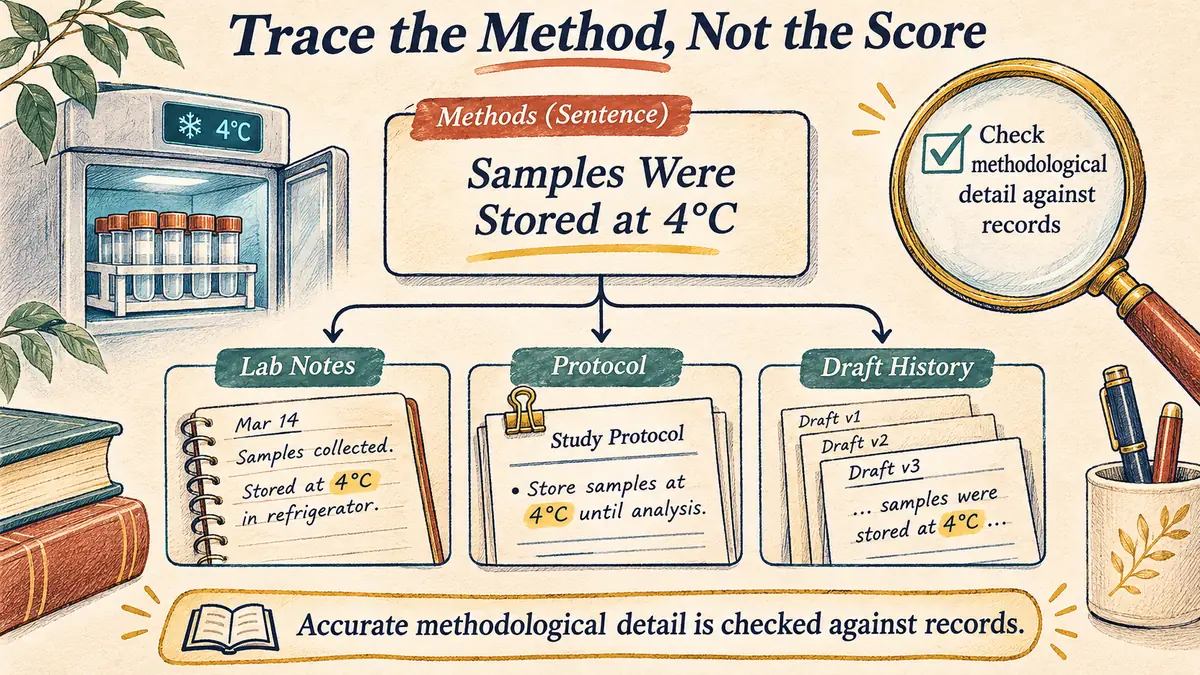
Descriptions such as “participants provided informed consent” or “samples were stored at 4°C” may recur because they name standard actions. Those phrases alone do not identify an authoring method. At the same time, a methods section can contain copied wording or unacknowledged assistance. Review the actual source and drafting context rather than assuming either innocence or misconduct from its style.
Technical Accuracy Is a Separate Check
A beautifully written methods section may describe an incorrect procedure. A formulaic one may describe the procedure precisely. Evaluate accuracy against lab notes, approved protocols, instrument records, or the assignment materials. Use the broader discussion of AI detector accuracy to understand the report's limits, then return to the concrete passage.
Match the Flagged Passage to the Right Evidence
Passage Under Review | Useful Record | What to Check |
|---|---|---|
Sampling and eligibility | Recruitment plan and inclusion criteria | The final description matches the actual sample and exclusions. |
Materials and procedure | Protocol, lab notebook, instrument record | Units, settings, sequence, and deviations are accurate. |
Data analysis | Analysis script, output, or calculation notes | The named method is the one actually used. |
Wording and revision | Draft versions and genuine feedback | How the description developed and which edits were made. |
These records answer different questions. An analysis script can substantiate an analytical choice, but it does not by itself prove who wrote the explanation. A version history can show edits, but it does not verify that an experiment occurred exactly as described. Combine relevant evidence without presenting any single item as conclusive.
Review the Section Without Damaging the Method
Preserve the submitted version. Save the file and report you were asked about. Record the tool and report date when available. Make further edits in a separate copy.
Identify the exact passage. Include the sentences before and after the highlight. Do not rely only on a cropped color block or the overall percentage.
Check the scientific description. Compare each material, measurement, setting, and analytical step with the underlying records.
Check borrowed language. If a procedure comes from a published protocol, identify that source and check whether quotation, paraphrase, and attribution follow the required style.
Document any correction. Explain what changed and why. “Restored the storage temperature from the lab record” is useful; “made it less detectable” does not explain scientific accuracy.
Keep participant identities, confidential research data, and other restricted material out of an evidence packet unless the authorized reviewer needs them and the applicable process permits sharing them. A concise explanation can often refer to a record without distributing the entire dataset.
Make Clarity Edits Only Where They Help
Hypothetical editing example: “Following completion of collection, storage of the samples was undertaken at a temperature of 4°C” could become “After collection, the samples were stored at 4°C.” The second version is shorter while retaining the stated action, timing, and temperature. This is an instructional example, not a detector test or a result from any product.
The revision would be wrong if the actual record required a specific storage duration that had been omitted. Before accepting the shorter sentence, check what the reader needs to reproduce or understand the procedure. Do not replace technical names with loose synonyms, add random variation, or invent a personal anecdote to alter the writing's appearance.
If permitted, Dr. Humanizer may help propose clearer phrasing after you have verified the method. Retain the original and check every suggested change against the records. A rewriting output does not establish that an earlier flag was false, and it should not be presented as an authorship certificate.
Prepare a Focused Explanation for the Reviewer
Organize the response around the questioned passage rather than a general argument about detectors. The explanation can be short and factual:
Location: identify the methods paragraph or sentences under review.
Writing process: explain when and how you drafted the description, including any assistance actually used.
Supporting material: point to relevant existing notes, protocol references, or versions.
Requested clarification: ask which point needs further explanation and whether a revision is requested.
Do not reconstruct earlier notes and present them as historical records. If a record is missing, say so. When a revision is requested, the pre-resubmission revision checklist can help organize the broader paper review.
FAQ
Does Passive Voice Make a Methods Section AI-Written?
No. Passive voice is a grammatical choice, not proof of authorship. Choose active or passive constructions according to clarity and disciplinary expectations. Neither choice guarantees a particular detector result.
Should I Run Only the Highlighted Sentence Through Another Detector?
A different tool or a smaller input does not recreate the original evaluation. Short passages may also fall outside a tool's supported conditions. Preserve the original report and review the sentence in context rather than treating a second score as an appeal verdict.
Can a Standard Protocol Be Paraphrased Freely?
You can explain a procedure in your own wording when appropriate, but retain technical precision and credit the source. Do not silently change steps or measurements, and follow any requirement to quote standardized wording exactly.
Conclusion
A methods-section AI flag calls for a contextual review of the text, the procedure, and the writing record. Preserve accurate details, explain conventional language where relevant, and correct genuine problems with a documented reason. The goal is a clear, supportable account of the research, not a more favorable detector number.