

Before resubmitting a paper after an AI detector concern, check the argument, source support, wording, and record of your revisions. Keep the submitted version unchanged, identify what your instructor wants reviewed, and make corrections you can explain. A useful AI detector revision checklist ends with a defensible paper and a clear revision record, not a target detector score.
This guide is a submission-readiness workflow. It helps you decide what to correct, what to keep, and what needs clarification before you send another file. It does not assume a detector flag proves AI use or that revising your writing will produce a particular result.

Preserve the File and Clarify the Request
Save the exact version that was reviewed, any feedback you received, and the assignment instructions. Work in a new copy. If you immediately replace the original, it becomes harder to show which passages changed and why.
Identify whether the concern comes from an AI writing report, a similarity report, or a reader's comments. Turnitin describes its AI writing percentage as separate from its similarity score and warns that its model can misidentify text. Its guidance says the result should not be the sole basis for adverse action against a student. Treat the report as context for a review, not a complete explanation of what happened.
Write down the requested action in one sentence. For example: “Check the evidence in paragraphs three and four and submit a revision note.” If the request is unclear, ask which passages need attention, whether a new submission is permitted, and what supporting material the instructor wants. Do not assume that repeated uploads are part of the assignment.
Gate 1: Can You Explain the Argument Without Reading It?
Put the draft aside and explain its central claim in a few sentences. Then identify what each main section contributes. If a paragraph has no clear role, it needs an argument-level decision before a sentence-level edit.
State the thesis in terms that answer the actual assignment.
Give each body paragraph a specific purpose: establish a reason, interpret evidence, address an objection, or qualify the claim.
Identify any conclusion that is stronger than the evidence presented.
Mark material that repeats another paragraph without adding analysis.
Ready to move on: you can explain why each paragraph is present and how it supports the paper's central claim. If you cannot, revise the outline or remove the unsupported detour. The research paper writing process provides a broader framework for rebuilding the connection between question, evidence, and structure.
Gate 2: Can You Trace Each Important Claim to Support?
Read the paper with the source material open. For every quotation, factual claim, and source-based paraphrase, locate the passage that supports it. A reference list entry is not enough if the cited source does not actually make the claim in the sentence.
Check | What counts as resolved |
|---|---|
Quotation accuracy | The wording matches the source, and any omissions or changes are represented correctly. |
Paraphrase meaning | The revision retains the original scope, qualifications, and attribution. |
Numbers and terms | Values, units, dates, and technical labels agree with the evidence. |
Inference | Your interpretation is distinguishable from the source's reported finding. |
Citation connection | The reader can tell which claim the citation supports and find the referenced source. |
If a reference cannot be verified, investigate it rather than replacing its title with a plausible-looking one. If the claim is not supported, narrow it, find suitable evidence you actually read, or remove it. Record the substantive decision in your revision log.
Gate 3: Does the Wording Preserve What You Mean?
Only after the argument and evidence checks should you polish the language. Focus on a specific reader problem: an unclear pronoun, a long sentence with competing points, an undefined term, or a transition that hides the relationship between ideas.
Invented editing example: “The interviews demonstrate that the policy improves student confidence” may overstate what a small interview project supports. If the evidence is limited to participants' reported experiences, a more accurate sentence might be: “Several participants described feeling more confident after the policy changed.” Whether that revision is justified depends on the actual interview material.
The reason for the change belongs in the log: “Limited the claim to participants' accounts.” Writing “made it sound more human” does not explain the correction. Avoid adding errors, slang, or personal anecdotes solely to change a detector response; those edits can weaken the paper without resolving a genuine writing problem.
If your course permits an editing tool, review its suggestions against your original and sources. This explanation of how an AI humanizer works can help distinguish wording assistance from verification. Keep accepted changes understandable and disclose tool use when your assignment requires it.
Gate 4: Can You Show What Changed and Why?
Use a short revision log organized by location, concern, action, and supporting check. You do not need to justify every comma. Concentrate on edits that affect the argument, evidence, attribution, or meaning.
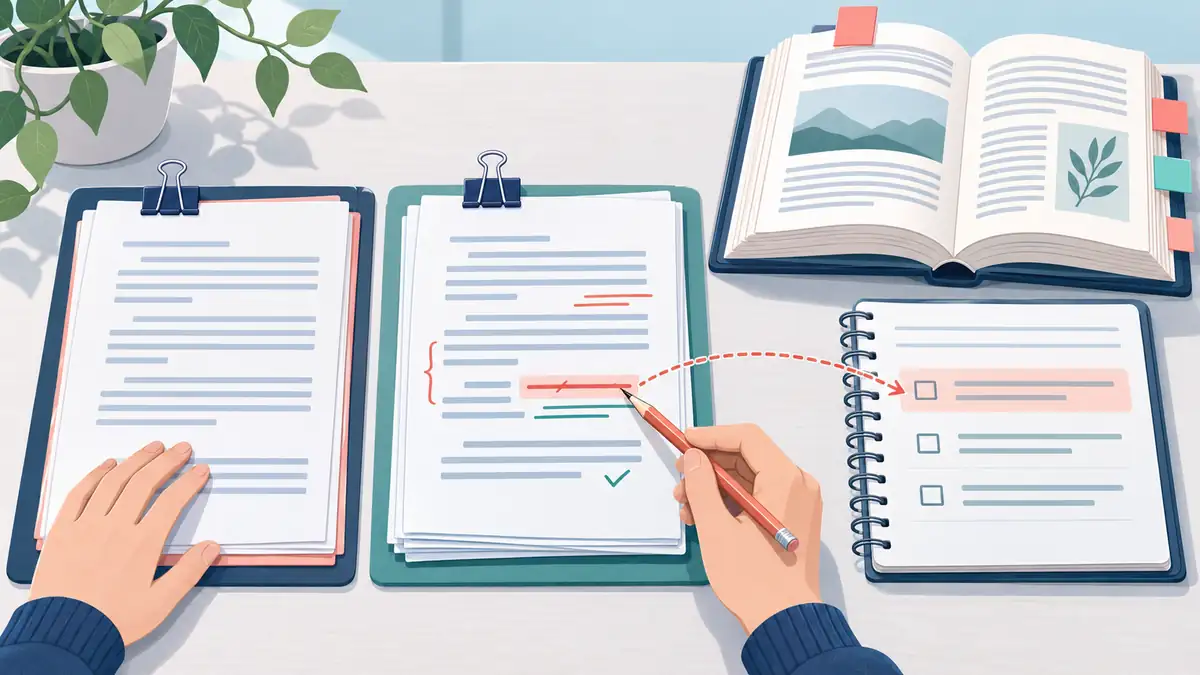
The following is a hypothetical log, not a real student's history or a reconstruction of an earlier draft.
Location | Concern | Action and check |
|---|---|---|
Paragraph 2 | A causal claim exceeded the evidence. | Changed the claim to an association and checked the source's methods and conclusion. |
Paragraph 4 | A paraphrase blurred the author's view and my interpretation. | Separated the two statements and placed the citation beside the source-based claim. |
Conclusion | A recommendation introduced a new, unsupported assumption. | Removed that recommendation and tied the closing point to the argument already developed. |
Keep the original, revised document, and log together. Preserve genuine notes and available version history; do not fabricate earlier drafts or backdate records. If you did not retain a particular stage, describe that gap honestly instead of presenting a newly written note as historical evidence.
Make the Resubmission Decision
Before sending the file, make a final pass using three outcomes. These are review decisions, not predictions about an instructor's judgment.
Ready: the requested revisions are complete, important claims are supported, the final file opens correctly, and you can explain the changes.
Needs clarification: the permission to resubmit, required disclosure, or requested evidence is unclear. Resolve that specific issue before sending another version.
Needs more work: a source is unverified, a major claim remains unsupported, or the revision no longer expresses your intended argument.
Open the actual attachment you intend to submit, not merely the editor's working copy. Check page order, tables, citations, comments, and file naming. Include only the supporting records requested or relevant to the concern, and keep a copy of what you send.
FAQ
Should I Rewrite Every Highlighted Sentence?
No. Review the passage for a concrete problem first. If the wording is accurate, clear, properly attributed, and yours to use, a highlight alone does not explain what needs rewriting. Ask for clarification where the concern remains unclear.
What If I Do Not Have a Complete Version History?
Preserve the records you do have: source notes, outlines, saved files, or feedback. Explain any missing stages accurately. A new revision log can document the work you do now, but it should not be presented as a record made earlier.
Does a Different Score Mean the Revision Was Better?
Not necessarily. Detector output does not assess whether an argument is supported. Turnitin also documents model updates that do not retroactively change earlier reports, so results from different dates may not be directly comparable. Judge the revision by the writing checks and assignment requirements.
Conclusion
A resubmission is ready when the paper answers the assignment, its evidence supports its claims, and its revisions can be explained. Preserve the original, work through the four review gates, and resolve any outstanding instruction or source issue before sending the final file. The strongest deliverable is a clear paper accompanied by an accurate account of the work you actually did.