

A flagged draft often needs better ownership, not a trick for hiding how it was made.
Students should revise toward clearer thinking and honest policy compliance.
The safest changes make the writing more specific, sourced, and genuinely connected to the assignment.
Quick Answer to How to Remove AI Detection from Text
The responsible way to remove AI detection from text is to revise the writing so it reflects your own reasoning, sources, and allowed process. Do not try to deceive an instructor or bypass a school policy.
Instead, replace generic claims with specific evidence, rewrite from your outline, vary sentence structure naturally, verify every citation, and disclose AI help when required. A humanizer may improve flow, but it cannot make prohibited AI use academically acceptable.
Start by Finding Generic Passages
Flagged passages often share the same problem: they sound complete but lack a real connection to the assignment. To identify AI-written text, look for broad claims, over-neat transitions, repetitive sentence openings, and conclusions that could fit almost any essay. Mark those sections for real revision. The goal is not to disguise the text; it is to make the paper say something specific and defensible.
For a student working through how to remove AI detection from text, this point matters because a detector report rarely explains the assignment context. The better habit is to connect the flagged language with a concrete draft decision: what source was used, what claim was revised, and what evidence changed between versions. That turns a vague concern into something the writer or instructor can actually evaluate.
Rewrite from Your Own Notes
Open your outline, source annotations, class notes, or lab results and rewrite the paragraph without looking at the questionable wording. This prevents shallow synonym changes. A real rewrite changes the claim, evidence, order, and explanation when needed. If you cannot explain the paragraph without the old wording, you probably need to rebuild the idea rather than polish the sentence.
In practice, how to remove AI detection from text should be reviewed alongside the paper's purpose. A scholarship essay, lab report, literature review, and discussion post all create different writing patterns. A fair review asks whether the form of the assignment explains some of the signal before assuming that a tool has found misconduct. That extra step protects both honest students and careful instructors.
Add Evidence and Citation Accuracy
AI-like writing often becomes more human when the argument engages with real sources. Add the author's point, page or section details, data limits, and your reason for using that source. Check that every citation exists and supports the sentence. Fabricated or vague citations create a bigger academic problem than a detector score.
The student-facing lesson is simple: keep the work traceable when how to remove AI detection from text could become a concern. Save outlines, notes, source summaries, and earlier drafts instead of relying on memory after submission. Those materials show the reasoning behind the paper, and they often answer questions that a detector report cannot see.
Use Humanizing Tools with Boundaries
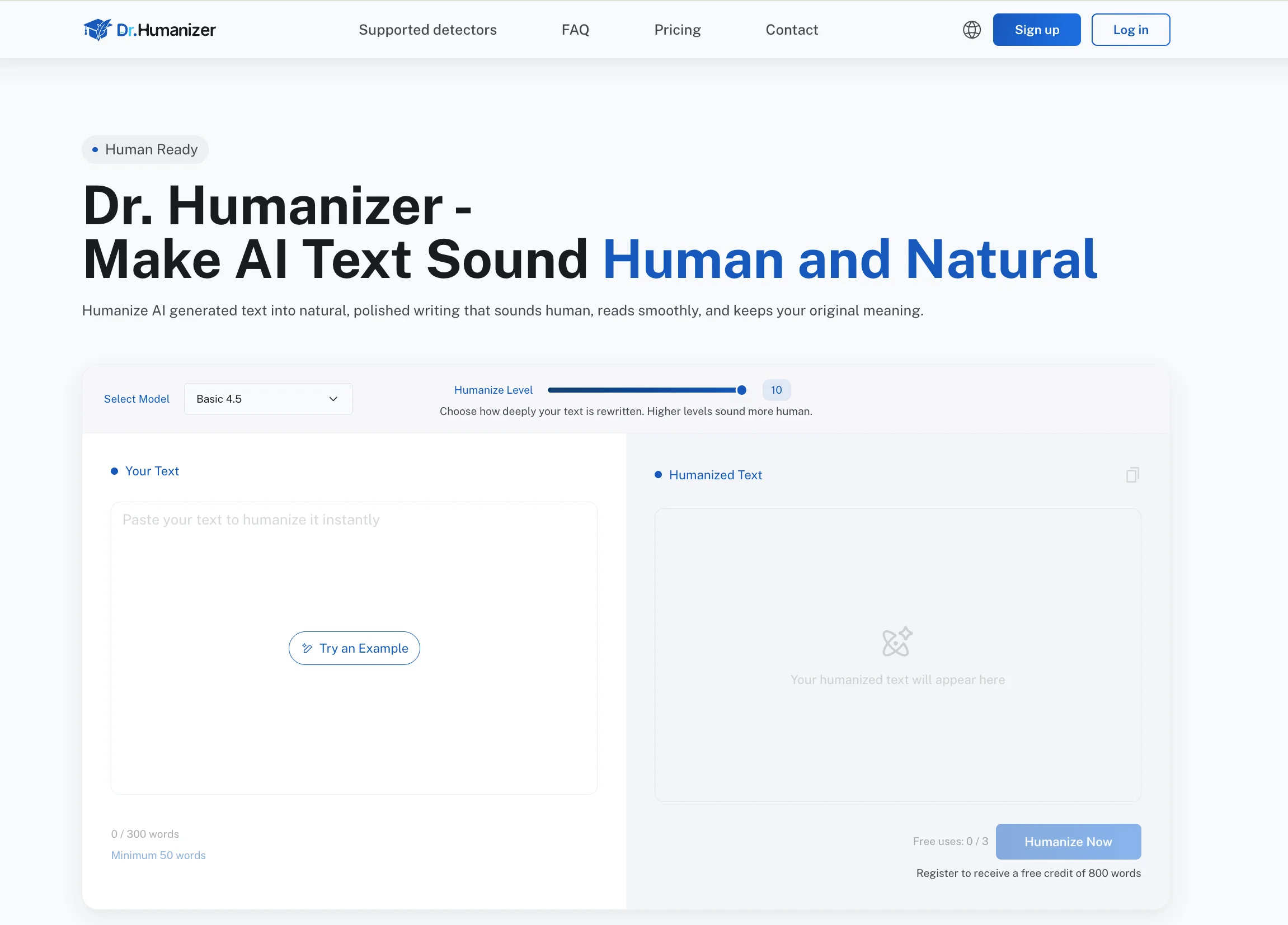
Dr. Humanizer can help reduce stiff AI-like rhythm and improve readability, especially when a permitted AI-assisted draft sounds robotic. It should be used as an editing aid, not as a way to hide misconduct. Students still need to verify facts, follow AI disclosure rules, and keep the final wording in their own voice.
A careful reader should also separate writing quality from authorship when considering how to remove AI detection from text. Fluent prose can be human, weak prose can be AI-assisted, and both can be revised. The useful question is whether the paragraph makes specific, verifiable choices that fit the assignment and whether the writer can explain those choices.
Keep Policy and Process Visible
Turnitin guidance emphasizes that AI reports should be interpreted with context and professional judgment. Students can support that context by saving drafts, prompts when disclosure is required, and notes that show revision. If the assistance fell outside the course's rules for acceptable AI use, the responsible fix may be restarting the assignment from scratch.
When the result affects a grade or integrity review, how to remove AI detection from text deserves a higher evidence standard. A quick scan may be fine for personal revision, but a serious decision should include policy language, drafts, source checks, and a chance for the student to respond. That approach treats technology as support for judgment rather than a replacement for it.
Key Takeaways
Responsible revision improves ownership rather than hiding prohibited AI use.
Rewrite from notes and sources, not from a flagged sentence you want to disguise.
Specific evidence, accurate citations, and clear reasoning reduce generic AI-like prose.
Humanizing tools do not override course policy or academic integrity rules.
FAQ
Can I Remove AI Detection by Paraphrasing?
Simple paraphrasing is risky and often weak. It may change a score, but it does not create original academic work if the structure and ideas still come from prohibited AI output.
Should I Use a Humanizer for School Work?
Only use one when your course policy allows AI-assisted editing and you still review the output carefully. A humanizer should improve readability, not replace your own analysis or disclosure responsibilities.
What Revision Helps Most?
Rewrite the claim, add source-specific evidence, explain your reasoning, and vary sentence structure naturally. The strongest revision makes the paragraph more accurate and more clearly yours.
What If AI Use Was Not Allowed?
Do not try to hide it. Restart from your own notes, ask your instructor for guidance if appropriate, and follow the course policy. Concealment can create a more serious integrity problem.
Will This Guarantee a Low AI Score?
No. No responsible method can guarantee detector results. The purpose is to produce honest, policy-compliant, well-supported writing that you can explain.
Conclusion
For students asking how to remove ai detection from text, the safest approach is to treat the flag as a revision warning, not a challenge to beat a system.
Make the writing more specific, more sourced, and more clearly connected to your own thinking. That protects both the paper and your academic integrity.
For how to remove ai detection from text, the most useful next step is to make the writing process visible. Keep the draft trail, review sources carefully, and treat any automated result as something to interpret with context rather than something to obey without question.