

To preserve citations while rewriting, keep the connection between each source and the claim it supports. Author names, years, and page numbers can remain unchanged while attribution becomes misleading. After splitting a sentence, combining findings, or moving a paragraph, check the source-to-claim relationship again.
This guide focuses on editing an existing academic draft with citations already in place. It does not replace learning a citation style or checking the sources themselves. Keep a copy of the original, work from verified references, and review the citation structure before polishing the final wording.
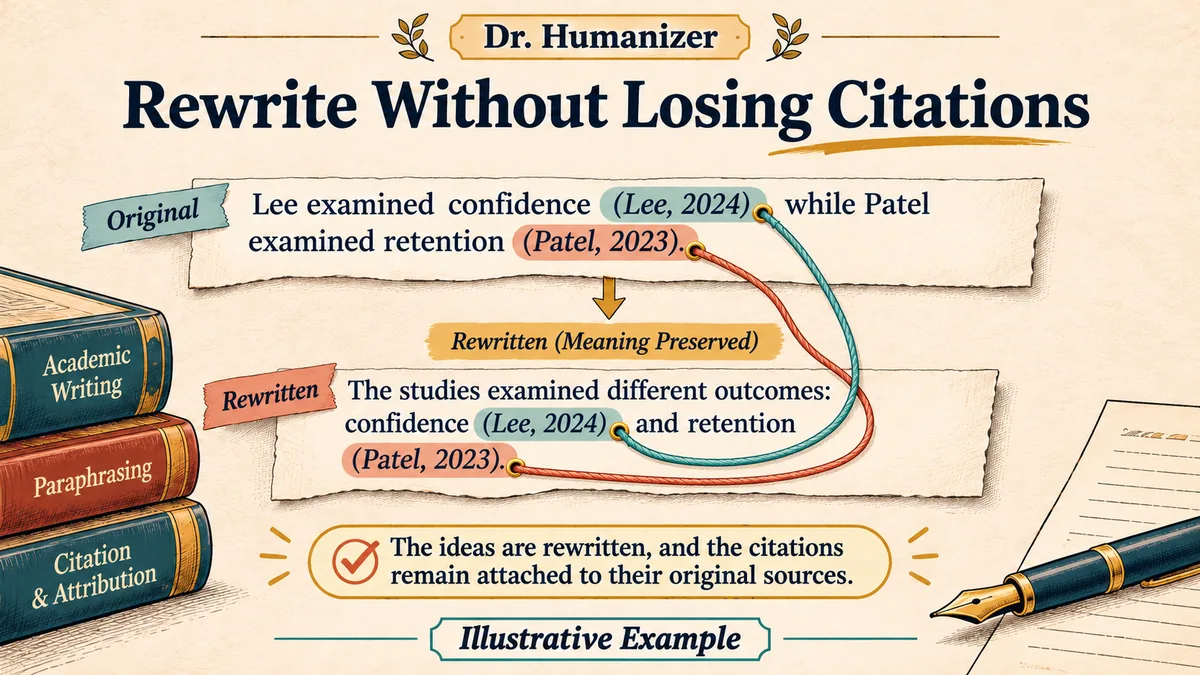
Treat the Claim and Its Citation as a Pair
A citation is not a decorative tag attached to a paragraph. It tells readers where a particular idea or piece of evidence came from. When you change sentence structure, the apparent scope of that tag may expand or shrink.
Before rewriting a dense paragraph, mark which clauses come from which sources and which statements are your own analysis. A private source map can be simple: claim, source, relevant location, and qualification. Use the real source material to confirm the mapping rather than assuming the original draft was correct.
Revision | What Can Break | What to Recheck |
|---|---|---|
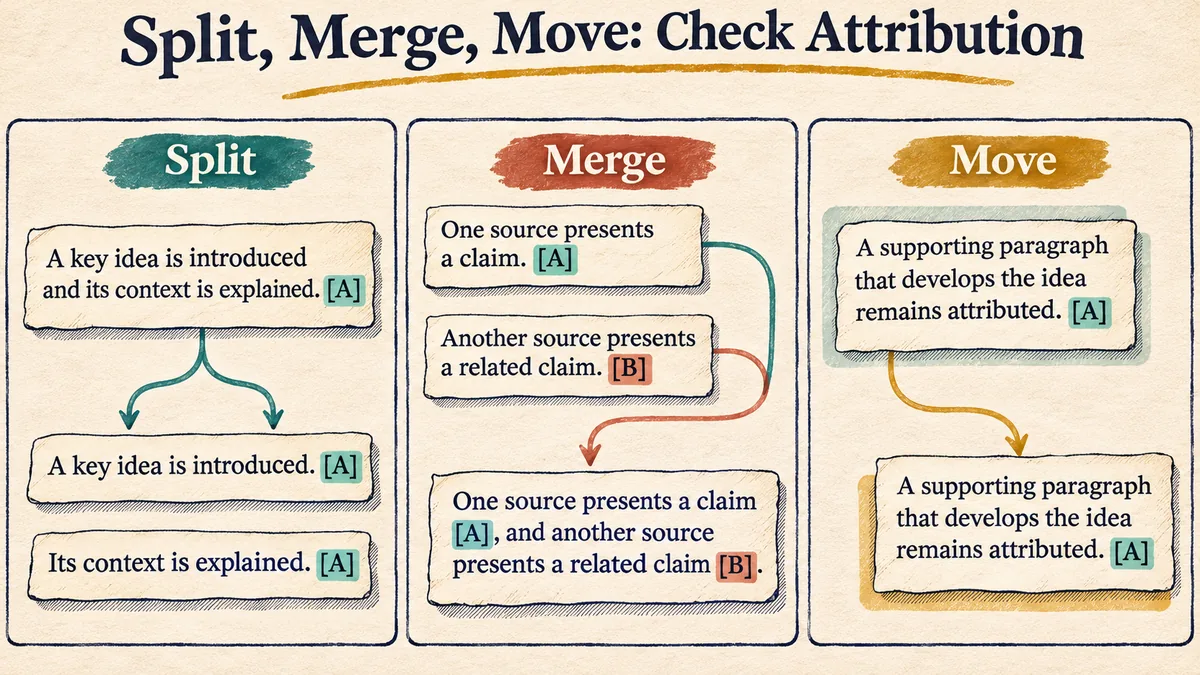
Split one sentence into two | The second sentence appears unsupported or independently authored. | Whether the source remains clear across both sentences. |
Merge two claims | Both citations appear to support both claims. | The specific contribution of each source. |
Move a paragraph | “The same study” now points to a different source. | Names, pronouns, locators, and surrounding context. |
Shorten a paraphrase | A limitation disappears while the citation remains. | Whether the source supports the stronger revised wording. |
Repair Attribution After Structural Edits
When You Split a Sentence
Read both resulting sentences without relying on the old punctuation. If they continue a clearly signaled discussion of the same source, the required style may not demand an identical parenthesis after every sentence. If the source becomes ambiguous, introduce the author or repeat the reference as needed.
APA guidance allows a paraphrase to continue across several sentences when the source remains clear after its initial citation. That does not mean a citation at the end of a paragraph automatically covers everything before it. Consult the specific APA in-text citation rules when using author-date references.
When You Merge Claims From Different Sources
Do not combine two sentences and move both citations to the end unless that placement accurately represents the evidence. Sometimes separate clauses with their own attribution are clearer than a compact sentence followed by a long group of references.
Invented example: Lee (2024) reported higher confidence after an activity; Patel (2023) examined attendance. A merged sentence saying “The activity improved confidence and attendance (Lee, 2024; Patel, 2023)” adds an outcome that the second source has not been described as finding. Preserve what each source actually supports before deciding where the citations belong.
When You Move a Paragraph
Check references that depend on context: “this study,” “the authors,” “the earlier analysis,” and similar phrases. A paragraph that followed a named source may become unclear under a new heading. Restore explicit attribution and reread the paragraph before and after it.
Also inspect quotations and locators. A copied page number can remain syntactically correct while pointing to a passage that no longer supports the revised claim. A citation manager can help preserve reference metadata, but it cannot decide whether your interpretation is accurate.
Keep Style Rules Separate From Meaning Checks
First establish which source supports the sentence. Then apply the assigned style. Mixing the two tasks can produce a polished reference to the wrong evidence.
APA paraphrases: normally identify author and year; a page or paragraph locator can help readers find material in a long or complex source.
Direct quotations: retain the exact quoted wording and the locator required by the style. Do not let a rewrite alter words inside quotation marks.
MLA references: keep the brief citation connected to the first element of the Works Cited entry and an appropriate available locator.
Numeric styles: if your required style numbers references by first appearance, moving material may require renumbering the citation sequence and reference list together.
For author-page writing, the guide to MLA parenthetical citations helps distinguish the locator from APA's year-based structure. Do not retain one style's punctuation simply because it survived an editing tool.
Use a Controlled Rewriting Workflow
Save the source draft. Preserve the original prose and its bibliography before making structural changes.
Identify protected material. Mark quotations, citation fields, technical terms, numbers, and locators that require exact handling.
Revise a coherent passage. Address a specific problem, such as an overloaded sentence or unclear contrast, while keeping the relevant evidence available.
Compare meaning first. Check the claim, population, condition, degree of certainty, and source ownership.
Check reference mechanics. Update fields using the document's reference workflow where applicable, then verify the rendered citations and bibliography.
If your assignment allows it, Dr. Humanizer can help suggest clearer wording. Review its output as a proposed edit, not as a citation-verification result. Keep the verified source map available and reject changes that merge distinct claims, remove qualifications, or modify quotations.
A plain-text copy may not preserve a word processor's live citation fields. Check your editor or reference manager's behavior before replacing a citation-rich passage. If fields do not survive the workflow, reinstate references through the supported citation mechanism and verify them again rather than trusting text that merely looks correct.
Perform a Two-Way Citation Audit
Read forward from the prose to the references: for each source-based claim, locate the cited work and confirm support for the revised statement. Then read backward from the reference list to the prose: identify where each entry is used and whether its spelling, year, and other identifying details match.
Do not remove an entry automatically just because it is not cited if your assignment calls for a broader bibliography. Follow the required list type. For a Works Cited or References list, resolve unexplained mismatches instead of leaving a source that disappeared during revision.
Final reading test: ask whether a reader could tell which words are quoted, which ideas are paraphrased, and which interpretation is yours without consulting an earlier draft. If the answer depends on what the paragraph used to say, the attribution needs repair.
FAQ
Does Keeping Every Parenthesis Preserve the Citations?
No. The punctuation can survive while the meaning changes. Check that each reference still supports the claim beside it and that the reader can identify the scope of the attribution.
Do I Need to Repeat an APA Citation in Every Sentence?
Not when a continuing paraphrase remains clearly attributed to the same source. Repeat or clarify the attribution when the source changes, the context becomes ambiguous, or the required presentation calls for it.
Can I Remove a Page Number After Shortening a Sentence?
Decide based on the source type, whether you are quoting or paraphrasing, and the citation style. Shortening alone is not a reason to remove a useful or required locator.
Conclusion
Preserving citations means preserving attribution, not just names and parentheses. After a structural edit, verify the claim against the source, repair the citation's scope, and check the reference list. A successful rewrite is easier to read while remaining just as traceable to its evidence.